Is Your Money Safe in Indian Banks, and How Does Deposit Insurance Protect You?
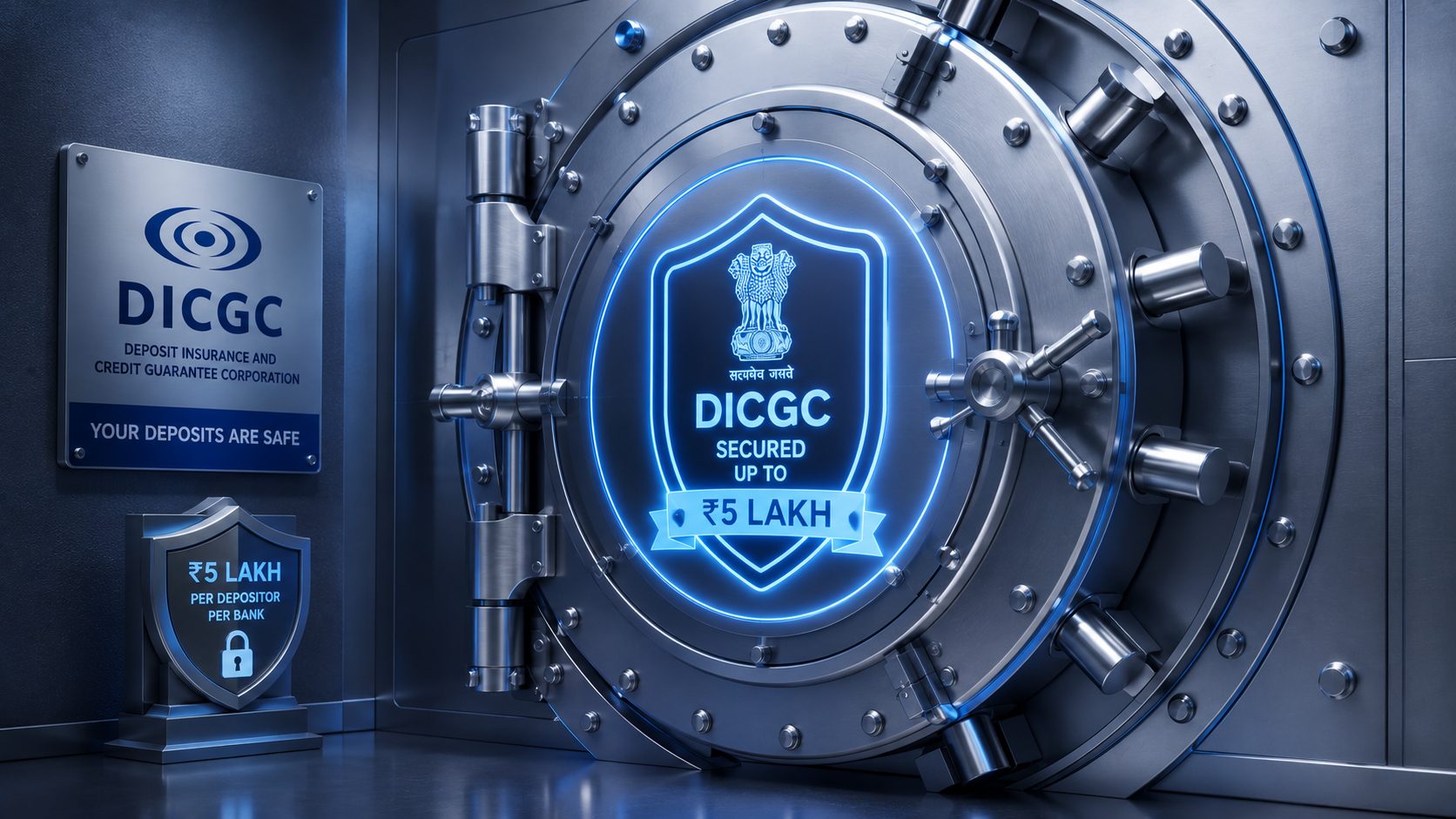
To ensure your bank deposits in India are 100% safe in 2026, you must keep your total combined balance (principal plus accrued interest) at any single bank under the statutory DICGC insurance limit of ₹5 Lakhs, or strategically distribute your capital across different banking institutions. The Deposit Insurance and Credit Guarantee Corporation (DICGC), a wholly owned subsidiary of the Reserve Bank of India (RBI), provides a sovereign guarantee that protects depositor funds in the event of a bank liquidation or license cancellation.
Quick Answer Summary
- Insurance Limit: Up to ₹5,00,000 (₹5 Lakhs) per depositor, per bank is covered. If a bank fails, you are guaranteed to recover up to this amount.
- What is Covered: Savings accounts, fixed deposits (FDs), recurring deposits (RDs), and current accounts are all covered. The limit includes both the principal amount and any accrued interest.
- Payout Timeline: Under the amended DICGC Act, payouts must be processed within 90 days of the RBI placing a bank under moratorium, providing fast liquidity to affected savers.
What Types of Banks and Accounts Are Covered by DICGC?
DICGC covers a wide range of banking institutions in India. All depositors—whether individuals, businesses, or trust accounts—enjoy the same safety net.
Eligible Banks Include:
- All Commercial Banks: State Bank of India (SBI), HDFC Bank, ICICI Bank, Axis Bank, and all other public and private sector banks.
- Foreign Bank Branches: Indian branches of foreign banks (e.g. Citibank, HSBC, Standard Chartered).
- Regional Rural Banks (RRBs): Rural banks providing local credit.
- Co-operative Banks: All urban, state, and district central co-operative banks operating in states that have passed cooperative bank legislation.
- Local Area Banks & Small Finance Banks: e.g., AU Small Finance Bank, Equitas Small Finance Bank.
Eligible Account Types Include:
- Savings bank accounts.
- Fixed Deposits (FDs).
- Current bank accounts.
- Recurring Deposits (RDs).
Note: Deposits from foreign governments, central/state governments, inter-bank deposits, and any reserves held outside India are excluded from coverage.
The "Same Capacity and Same Right" Rule Explained
The ₹5 Lakh insurance limit applies to all accounts held by a depositor in the "same capacity and same right" at a single bank. This is a critical distinction that dictates how deposits are aggregated:
- Single Accounts (Same Capacity): If you own a savings account with ₹2 Lakhs and a fixed deposit with ₹4 Lakhs under your sole name at Bank A, your total balance is ₹6 Lakhs. If Bank A fails, you will only receive ₹5 Lakhs from the DICGC. The remaining ₹1 Lakh is uninsured.
- Joint Accounts (Different Capacity): If you hold a sole account with ₹4 Lakhs at Bank A, and a joint account with your spouse (where you are the primary holder) with ₹3 Lakhs, these are treated as different capacities. Both accounts are insured up to ₹5 Lakhs separately. You keep the full ₹7 Lakhs!
- Different Banks: If you hold ₹5 Lakhs at Bank A and ₹5 Lakhs at Bank B, both balances are insured independently. You are 100% covered for ₹10 Lakhs.
Case Study: Rahul's Bank Safety Strategy in 2026
Let's return to Rahul, our 28-year-old software developer in Bengaluru. Rahul has accumulated ₹12,00,000 in savings which he plans to use for a home down payment in two years. He wants to keep this money safe in fixed deposits.
Let's compare two deposit strategies for Rahul:
Strategy A: Depositing All in One Bank
Rahul places all ₹12 Lakhs in a single fixed deposit at a local co-operative bank offering a high 8.5% interest rate:
- Total Balance: ₹12,00,000
- DICGC Covered Amount: ₹5,00,000
- Uninsured Risk: ₹7,00,000
- Verdict: Extremely risky. If the co-operative bank's license is cancelled by the RBI, Rahul risks losing ₹7 Lakhs.
Rahul's ₹12 lakh in one co-operative bank
Strategy B: Splitting Across Three Banks
Rahul splits his ₹12 Lakhs into three fixed deposits of ₹4 Lakhs each at three separate commercial banks (Bank A, Bank B, and Bank C):
- Bank A Balance: ₹4,00,000 (100% insured)
- Bank B Balance: ₹4,00,000 (100% insured)
- Bank C Balance: ₹4,00,000 (100% insured)
- Total Insured Amount: ₹12,00,000
- Verdict: 100% safe. Even if all three banks fail simultaneously, Rahul's entire ₹12 Lakhs is backed by DICGC.
The 90-Day Payout Rule: Faster Access to Your Cash
Historically, when an Indian bank failed (such as PMC Bank or Yes Bank's moratorium), depositors had to wait years for liquidators to wind down the bank's assets before receiving insurance payouts.
To resolve this, the Government of India amended the DICGC Act:
- Day 1 to 45: The troubled bank must compile list of all outstanding deposits and submit it to the DICGC.
- Day 46 to 90: The DICGC verifies the claims and deposits the insured funds (up to ₹5 Lakhs per depositor) directly into their linked bank accounts.
The DICGC payout clock after a bank failure
- This 90-day mandate ensures that even during a bank failure, depositors do not face prolonged financial distress.
Use the Emergency Fund Calculator to compute your cash buffer and model how to safely distribute your reserves.
Advanced Strategic Implementation & Optimization for Bank Safety
Understanding the DICGC deposit insurance scheme is vital for protecting your cash savings across Indian banks.
Deposit Protection Checklist
- Distribute Balances Across Banks: Keep cash holdings below ₹5 Lakhs per bank to ensure full insurance coverage.
- Use Different Ownership Capacities: Use joint accounts and sole proprietorship accounts to increase insurance limits at a single bank.
- Verify DICGC Registration: Ensure your bank is a registered member of the deposit insurance scheme.
Step-by-Step Cash Allocation Strategy
- Audit Total Deposits: Sum your savings, fixed deposits, and recurring deposits at each bank.
- Identify Excess Balances: Flag any bank where your combined principal and interest exceeds ₹5 Lakhs.
- Open Accounts at Separate Institutions: Transfer excess cash to another licensed commercial or public-sector bank.
- Optimize Joint Ownerships: Structure accounts in different names (e.g., self, spouse, joint) to claim separate insurance limits.
Common Pitfalls & Audit Warnings
- Assuming Unlimited Coverage: Believing your entire balance is safe during a bank failure is incorrect; anything above ₹5 Lakhs is uninsured.
- Counting Branches Separately: Multiple accounts across different branches of the same bank are aggregated under a single ₹5 Lakh limit.
- Ignoring Interest Accruals: Forgetting that interest balances count toward the ₹5 Lakh insurance limit can push you into uninsured territory.
Advanced Savings Accumulation & Compound Scenarios
To illustrate deposit protection under DICGC rules, we analyze three deposit distribution scenarios for an investor holding ₹15 Lakhs in cash.
Cash Protection Comparison Table
| Metric | Setup A: Single Account | Setup B: Multi-Branch | Setup C: Multi-Bank |
|---|---|---|---|
| Total Cash | ₹15,00,000 | ₹15,00,000 | ₹15,00,000 |
| No. of Banks Used | 1 Bank | 1 Bank (3 Branches) | 3 Separate Banks |
| Accounts Layout | Savings Account | Savings + FD | 3 Savings Accounts |
| Max Insured Limit | ₹5,00,000 | ₹5,00,000 | ₹15,00,000 |
| Uninsured Risk | ₹10,00,000 | ₹10,00,000 | ₹0 |
₹15 lakh: uninsured amount by deposit layout
Step-by-Step Risk Mitigation
Setup B: The Multi-Branch Illusion (High Risk)
- The Mistake: The depositor splits ₹15 Lakhs across three different branches of the same bank.
- Aggregation Rule: DICGC combines all accounts held in the same capacity at the same bank.
- The Result: Total insurance remains capped at ₹5 Lakhs, leaving ₹10 Lakhs at risk.
Setup C: Multi-Bank Distribution (Zero Risk)
- The Solution: Split the cash into three deposits of ₹5 Lakhs each at three completely separate banks.
- The Protection: Each bank carries a separate DICGC insurance guarantee.
- The Result: The entire ₹15 Lakhs is 100% insured.
4. What Happens Step-by-Step If Your Bank Fails in India?
Under the DICGC (Amendment) Act, depositors do not have to wait years for a failed bank to liquidate to get their money back. The DICGC is legally required to pay out insured deposits within 90 days of the RBI placing a bank under moratorium.
The 90-Day Timeline
- First 45 Days: The failed bank compiles list of depositors and submits the claim details to the DICGC.
- Next 30 Days: The DICGC verifies the claims and processes the payments.
- By Day 90: The money is credited directly to the depositors' bank accounts at other banks.
5. How to Protect Deposits Above ₹5 Lakhs: The Multi-Bank Strategy
Because the DICGC limit is ₹5 Lakhs per depositor, per bank, you can protect larger balances by distributing them across different banking entities.
The Strategy
- Different Banks: If you hold ₹5 Lakhs in Bank A and ₹5 Lakhs in Bank B, both balances are fully insured.
- Different Right and Capacity: If you hold ₹5 Lakhs in a personal account, and another ₹5 Lakhs in a joint account (with a spouse) at the same bank, both accounts are treated as held in different "rights and capacities" and are fully insured separately, protecting ₹10 Lakhs total at a single bank.
6. How to Verify If Your Bank is Covered by the DICGC
To ensure your savings are fully protected, you should verify that your bank is officially registered with the DICGC.
- The List of Insured Banks: The DICGC maintains a regularly updated directory of insured banks on its official website.
- Types of Banks Covered: Coverage extends to all commercial banks, local area banks, regional rural banks (RRBs), cooperative banks, and Indian branches of foreign banks. NBFCs (Non-Banking Financial Companies) and primary cooperative societies are NOT covered.
- The Logo display: Insured banks are required to display the DICGC insurance logo and certificate prominently at their branches and on their online portals.