
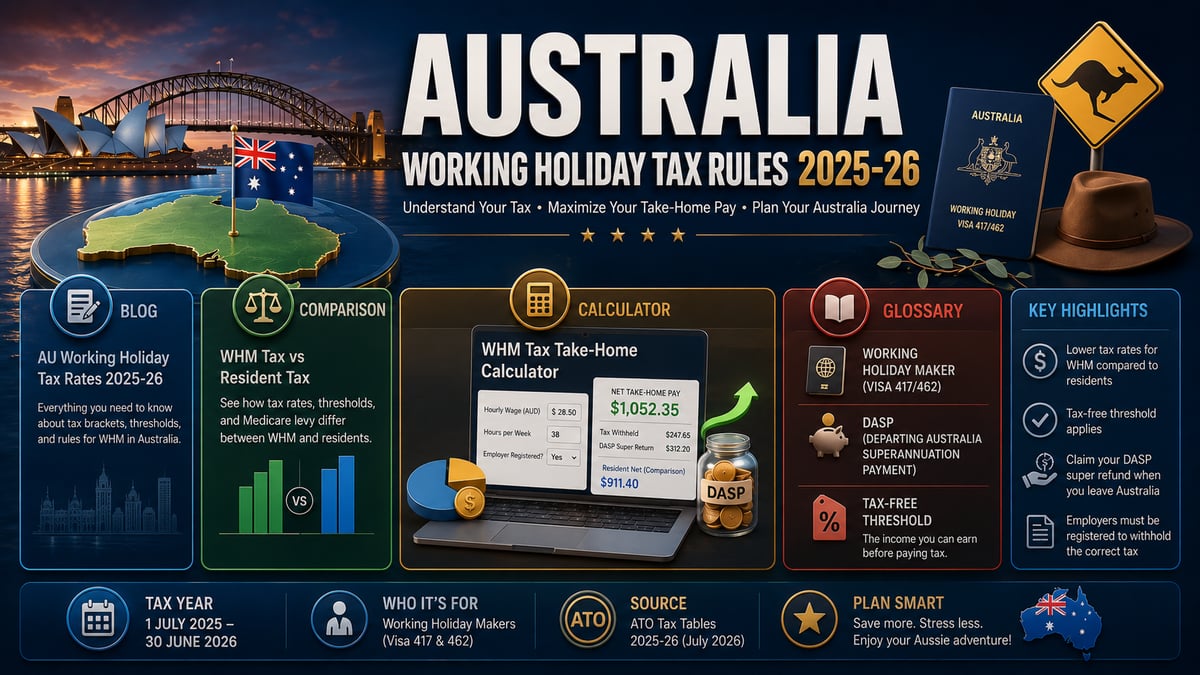
Introduction: Working and Paying Tax in Australia on a Working Holiday
Australia is one of the most popular destinations in the world for working holidays, inviting thousands of young travelers each year on Subclass 417 (Working Holiday) and Subclass 462 (Work and Holiday) visas. While wages in Australia are relatively high, understanding your tax obligations is essential to avoid unexpected debts or having too much money withheld from your pay.
Taxation for Working Holiday Makers (WHMs) is subject to unique rules administered by the Australian Taxation Office (ATO). The most critical difference between a WHM and a standard Australian tax resident is that Working Holiday Makers generally do not receive the $18,200 tax-free threshold. This means you pay tax on every single dollar you earn from day one.
The Non-Discrimination Article (NDA) Exception
A key but often overlooked legal exception exists under the ATO's Non-Discrimination Article (NDA) rules. If you are a Working Holiday Maker who is a resident of Australia for tax purposes AND you hold citizenship from one of the following 8 countries: United Kingdom, Germany, Japan, Chile, Finland, Israel, Norway, or Turkey, you are legally taxed as a standard resident. This means you do receive the $18,200 tax-free threshold and are taxed at standard resident rates, rather than flat WHM rates.
This guide provides an exhaustive breakdown of the WHM tax structure for the 2026-2027 financial year, compares registered vs. unregistered employer rates, details superannuation DASP refunds, and provides an interactive policy checkup.
WHM vs. Tax Resident Withholding Matrix (2026-2027)
| Gross Annual Income | Registered WHM Tax Rate | Unregistered WHM (Foreign) Rate | Standard Tax Resident Rate |
|---|---|---|---|
| $0 – $18,200 | 15% flat rate | 30% flat rate | 0% (Tax-Free Threshold) |
| $18,201 – $45,000 | 15% flat rate | 30% flat rate | 15% on amount over $18,200 |
| $45,001 – $135,000 | 30% on amount over $45,000 | 30% flat rate | 30% on amount over $45,000 |
| $135,001 – $190,000 | 37% on amount over $135,000 | 37% on amount over $135,000 | 37% on amount over $135,000 |
| $190,001 and over | 45% on amount over $190,000 | 45% on amount over $190,000 | 45% on income over $190,000 |
| Medicare Levy | Exempt (0%) | Exempt (0%) | 2.0% of taxable income |
Important
To benefit from the low 15% flat tax rate, your employer must be registered with the ATO as a WHM employer. If they are not registered, they are legally required to withhold 30% from your pay. For more information, see our Working Holiday Maker Glossary Entry.
1. Registered vs. Unregistered Employers: The 15% vs. 30% Trap
Under Australian law, any business that employs Working Holiday Makers must register with the ATO. This registration is free and simple for employers, but it has a massive impact on the employee's take-home pay:
Registered WHM Employers
When working for a registered employer, you are taxed at a flat rate of 15% on your first $45,000 of gross earnings. This rate is highly competitive and allows travelers to retain most of their earnings for travel expenses. For example, on a gross wage of $1,000, a registered employer withholds $150, leaving you with $850 net.
Unregistered Employers
If an employer fails to register with the ATO, they are prohibited from using the 15% rate. Instead, they must withhold tax at foreign resident rates, which is a flat 30% from the very first dollar of income. On the same $1,000 gross wage, an unregistered employer must withhold $300, leaving you with only $700 net take-home.
Caution
If too much tax is withheld by an unregistered employer, you can claim the difference back as a refund when you file your tax return at the end of the financial year (June 30). However, this locks your cash up for months. Always check your payslips early and use our WHM Net Pay Calculator to audit your payroll.
2. Superannuation and the Departing Australia Superannuation Payment (DASP)
In addition to your gross wages, employers in Australia must contribute to your retirement savings, known as Superannuation (Super). Under the Superannuation Guarantee (SG) rules, employers must contribute 12.0% of your ordinary hours earnings into your nominated super fund for the 2026-2027 financial year.
Super Entry Tax
When your employer pays super into your fund, the super fund automatically deducts a 15% tax (concessional contributions tax). The remaining 85% is invested in the fund.
Claiming Your Super Refund (DASP)
Once you finish your working holiday, depart Australia, and your visa has expired or been cancelled, you can claim a refund of your accumulated super balance. This refund is called the Departing Australia Superannuation Payment (DASP).
However, because these funds were intended for retirement in Australia, the government discourages temporary workers from taking them out. The ATO levies a high withholding tax rate of 65% on DASP refunds for Working Holiday Makers. This means you only receive 35% of your accumulated super balance upon exit. To understand super rules, consult the DASP Glossary Entry.
3. Medicare Levy Exemptions: Claiming Your 2% Back
Standard Australian tax residents must pay a 2.0% Medicare levy on their taxable income to fund the public health system (Medicare). Because Working Holiday Makers are temporary residents and do not have access to Medicare services, WHMs are exempt from the Medicare levy.
However, this exemption is not applied automatically by employers during the year; they will withhold tax based on standard tables. To claim your 2% Medicare levy back, you must follow this process:
- Apply for a Medicare Entitlement Statement (MES): Submit an application to Services Australia proving that you were not entitled to Medicare benefits during the financial year.
- Declare Exemption on Tax Return: Once you receive the MES certificate, declare the number of exempt days (typically 365) on your annual tax return. The ATO will then calculate your tax refund, adding the 2% Medicare levy withholding back to your payout.
Visa Comparison: Subclass 417 vs 462
Both visa types are treated identically for tax purposes, but the eligibility requirements differ:
| Feature | Subclass 417 (Working Holiday) | Subclass 462 (Work and Holiday) |
|---|---|---|
| Eligible Countries | UK, Ireland, Canada, France, Germany, Italy, Japan, South Korea, Taiwan, Netherlands, and 9 others | USA, Argentina, Chile, China, Indonesia, Malaysia, Thailand, Vietnam, Spain, Portugal, and ~20 others |
| Age Limit | 18-30 (18-35 for UK, Canada, France, Ireland, Italy, Denmark, Germany, Finland, Cyprus, and South Korea) | 18-30 |
| Visa Duration | 12 months | 12 months |
| Extension | 2nd and 3rd year with specified work | 2nd and 3rd year with specified work |
| Education Requirement | None | Usually requires tertiary qualification or relevant study |
For UK passport holders who applied on or after July 1, 2024, the specified work requirement for second and third year extensions has been waived. This makes the 417 visa significantly more flexible for British backpackers.
Detailed Tax Calculation Examples
Example: Earning AUD $40,000 Over 6 Months
You work hospitality jobs in Sydney and Melbourne for 6 months, earning a total of AUD $40,000.
With a registered WHM employer:
- 15% tax on $40,000 = AUD $6,000
- Medicare levy: $0 (exempt)
- Net take-home: AUD $34,000
Compare this with a standard Australian resident earning $40,000:
- Tax-free threshold: $0 on first $18,200
- 15% on $18,201 to $40,000 = $3,270 (2026-27 rate)
- Medicare levy (2%): $800
- Net take-home: AUD $35,930
Tax on $40,000: WHM vs Australian resident
The difference is only $1,930 — far less than many backpackers assume. The lack of a tax-free threshold for WHMs mostly hurts those earning under $20,000.
Example: Earning AUD $55,000 (Higher-End Role)
If you land a professional role on a WHM visa earning $55,000:
- First $45,000 at 15% = $6,750
- Next $10,000 at 30% = $3,000
- Total tax: $9,750
How a $55,000 WHM salary is taxed
- Net take-home: AUD $45,250
The jump from 15% to 30% at $45,000 creates a noticeable tax increase. If you can keep your income under $45,000, you stay entirely in the 15% bracket.
How to Lodge Your Tax Return From Overseas
Many WHM visa holders leave Australia before June 30 and need to lodge their return from their home country. The process is entirely online:
- Log in to your myGov account (linked to the ATO)
- Navigate to the tax return section
- The ATO will have your income information pre-filled from Single Touch Payroll data (your employer reported it)
- Check that your WHM tax rates were applied correctly
- Claim the Medicare levy exemption using your Medicare Entitlement Statement
- Submit and wait for any refund to be deposited to your nominated bank account
Refunds are typically processed within 14 business days if lodged electronically. The ATO can deposit refunds to overseas bank accounts, though it may take slightly longer.
What Happens If You Have a HECS-HELP Debt
Working holiday makers who previously studied in Australia and have a HELP debt should be aware of the rules. As of 2026-27, the repayment threshold is $67,000, and repayments are calculated on a marginal basis — the repayment percentage applies only to income above the threshold, not your entire income.
However, a quirk: WHM visa holders are not eligible to take out new HECS-HELP loans while on the visa. If you already have a HELP debt from previous study in Australia, your compulsory repayments are calculated based on your worldwide income. When you leave Australia, you can make voluntary repayments to avoid indexation and currency fluctuation risks.
Superannuation Fund Choice
You are not required to use your employers default super fund. You can choose your own fund. For working holiday makers who will claim DASP later, a low-cost industry fund or a fund with good online access is usually the best choice. Avoid funds with high insurance premiums or account-keeping fees that will erode your small balance.
Before leaving Australia, consolidate any multiple super accounts into one. Small accounts spread across multiple funds get eaten up by fees. Use the ATOs online super search to find lost accounts, then consolidate them into your chosen fund before applying for DASP.
The Step Change After $45,000
A critical detail that catches many higher-earning WHMs: once you cross $45,000, the tax rate on every dollar above that threshold jumps from 15% to 30%. This creates a sharp effective marginal rate increase. If you are earning close to $45,000, consider whether taking on extra work that pushes you over this threshold is worth the higher tax rate on those additional dollars.
For example, earning $45,000 results in $6,750 tax (15% effective). Earning $50,000 results in $6,750 + $1,500 = $8,250 tax (16.5% effective). The extra $5,000 in earnings costs you $1,500 in tax — a 30% marginal rate on that top slice.
The step change after $45,000
Avoiding Common Mistakes
Three mistakes repeatedly catch working holiday makers off guard:
- Not checking employer registration: If your employer is not registered with the ATO as a WHM employer, they will withhold tax at 30% instead of 15%. Always verify on your first payslip. If the withholding is wrong, you can only recover it by lodging a tax return at year end.
- Forgetting to claim Medicare levy exemption: Most WHMs are entitled to a full Medicare levy exemption, but it is not automatic. You must apply for a Medicare Entitlement Statement from Services Australia and declare it on your tax return. Without this, you overpay 2% of your taxable income.
- Leaving super unclaimed: Many backpackers leave Australia without claiming their DASP, thinking the balance is too small to bother with. Even $500 in super, after the 65% DASP tax, becomes $175. That is a free $175 for 10 minutes of online paperwork. Dont walk away from it.