What this choice actually costs you
The missing threshold: where the $2,155 gap comes from
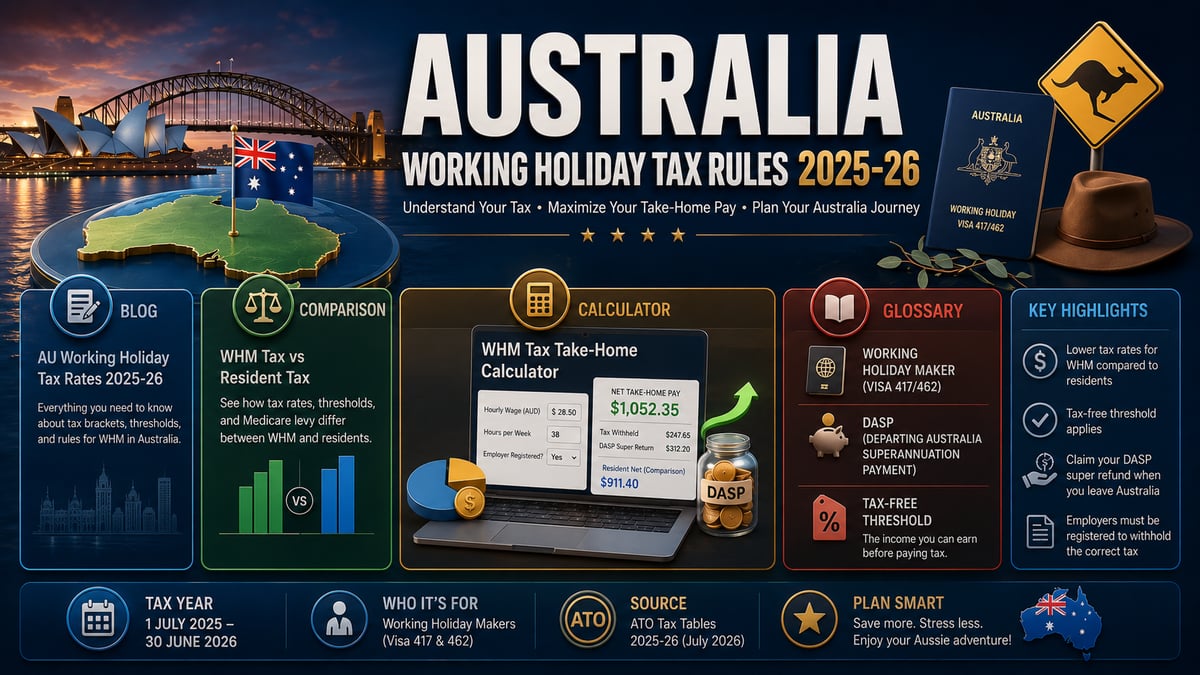
Meet Lena from Ireland, picking fruit and pulling beers on a 417 visa, and her flatmate Sam, an Australian resident doing the same job. Both gross $45,000 in 2026-27. Sam's first $18,200 is tax-free, the next $26,800 is taxed at the new 15% Stage 3 rate ($4,020), LITO hands back $325, and the Medicare levy adds $900: about $4,595 all up.
Lena pays 15% on everything from dollar one: $6,750. No threshold, no LITO; the Medicare exemption saves her $900, but she still lands $2,155 behind Sam on identical work.
The gap is regressive: at $18,200 of income it is $2,730 versus zero. Ireland is not one of the eight non-discrimination treaty countries, so Lena has no way around it, but a German or British workmate who genuinely resides in Australia does, and should read the third section below.
The 65% goodbye tax on your super
Every payday, Lena's employer must pay 12% super on top of her wages: about $5,400 a year on $45,000, and since 1 July 2026 it lands in her fund within days of each payslip. Sounds like forced savings. For a WHM it is mostly forced taxation.
When Lena leaves Australia and her visa expires, she claims the Departing Australia Superannuation Payment. The withholding on the taxable component is a flat 65% for working-holiday visa holders. Her $5,400 becomes roughly $1,890 in her pocket: the other $3,510 stays with the ATO.
Plan around it, don't fight it: the rate is set by law and applies no matter which fund you use. Treat your effective super benefit as about 4% of wages, not 12%, when comparing job offers against home-country pay. And still claim the DASP: around a third of your money back beats the alternative, which is your super sitting unclaimed until the ATO absorbs it.
Two checks worth over $2,000: registration and the treaty list
Check one takes a minute: is your employer registered with the ATO as a WHM employer? Registered means 15% withholding on your first $45,000. Unregistered means the law forces them to withhold 30% from the first dollar, $13,500 instead of $6,750 on a $45,000 year. You eventually get the excess back at tax time, but that is your cash flow gone for up to a year. Ask before you accept the job; registration is free and instant for the employer.
Check two is your passport. Australia's tax treaties with the UK, Germany, Japan, Chile, Finland, Israel, Norway and Turkey contain non-discrimination articles: citizens of those countries who genuinely qualify as Australian tax residents (the ordinary residency test — settled pattern of living here, not just a long trip) are entitled to resident rates: the $18,200 threshold, LITO, the lot.
That is the full $2,155-a-year swing at $45,000, claimable via your tax return: the ATO accepts amendments for past years too, following the Addy High Court decision. If you hold one of those eight passports and spent a year living and working in one place, running this past a tax agent is likely the best-paid hour of your working holiday.