When is the Right Time to Refinance Your Mortgage?
To determine if refinancing your mortgage is financially optimal in 2026, you must calculate the break-even timeline: divide the total upfront closing costs (appraisal, title, origination fees) by your projected monthly payment savings. If you plan to remain in the home longer than this break-even number of months, refinancing will save you money; otherwise, the upfront costs will exceed your savings.
Quick Answer Summary
- The Rule of Thumb: Refinancing is generally beneficial if you can lower your interest rate by at least 0.75% to 1.00%, and you plan to stay in the house for at least two to three years.
- The Formula: Break-Even Months = Total Refinancing Closing Costs ÷ Monthly Payment Savings
- Closing Costs: Expect to pay 2% to 5% of the loan amount in transaction fees to execute a refinance.
Why Do Homeowners Refinance Their Loans?
Refinancing replaces your existing home loan with a new one under different terms. The most common reasons include:
- Securing a Lower Interest Rate: The primary driver. Dropping your rate reduces your monthly payment and saves massive amounts of interest over the life of the loan.
- Reducing the Monthly Payment: Spreading out payments or securing a lower rate provides immediate monthly cash flow relief.
- Shortening the Loan Term: Swapping from a 30-year fixed to a 15-year fixed mortgage allows you to pay off your home twice as fast and save thousands in interest, though your monthly payment will increase.
- Cashing Out Equity (Cash-Out Refi): Borrowing more than you owe on the home and taking the difference in cash to fund major renovations or consolidate high-interest debt.
- Swapping Loan Types: Switching from an Adjustable-Rate Mortgage (ARM) to a stable Fixed-Rate Mortgage to lock in your payment long-term.
The Refinancing Closing Costs Breakdown
Refinancing is not free. Lenders charge several transaction fees to process, underwrite, and close your new loan:
- Application & Origination Fees: Charged by the lender for evaluating and creating the loan (typically 0.5% to 1.0% of the loan balance).
- Home Appraisal Fee: Required to verify the current market value of your property (typically $400 to $600).
- Title Search & Title Insurance: Paid to verify there are no liens on the property and protect the lender against title defects (typically 0.5% of the loan value).
- Recording & Notary Fees: Paid to your local county government to record the new deed (typically $100 to $200).
Case Study: David & Clara's Refinance Math (2026)
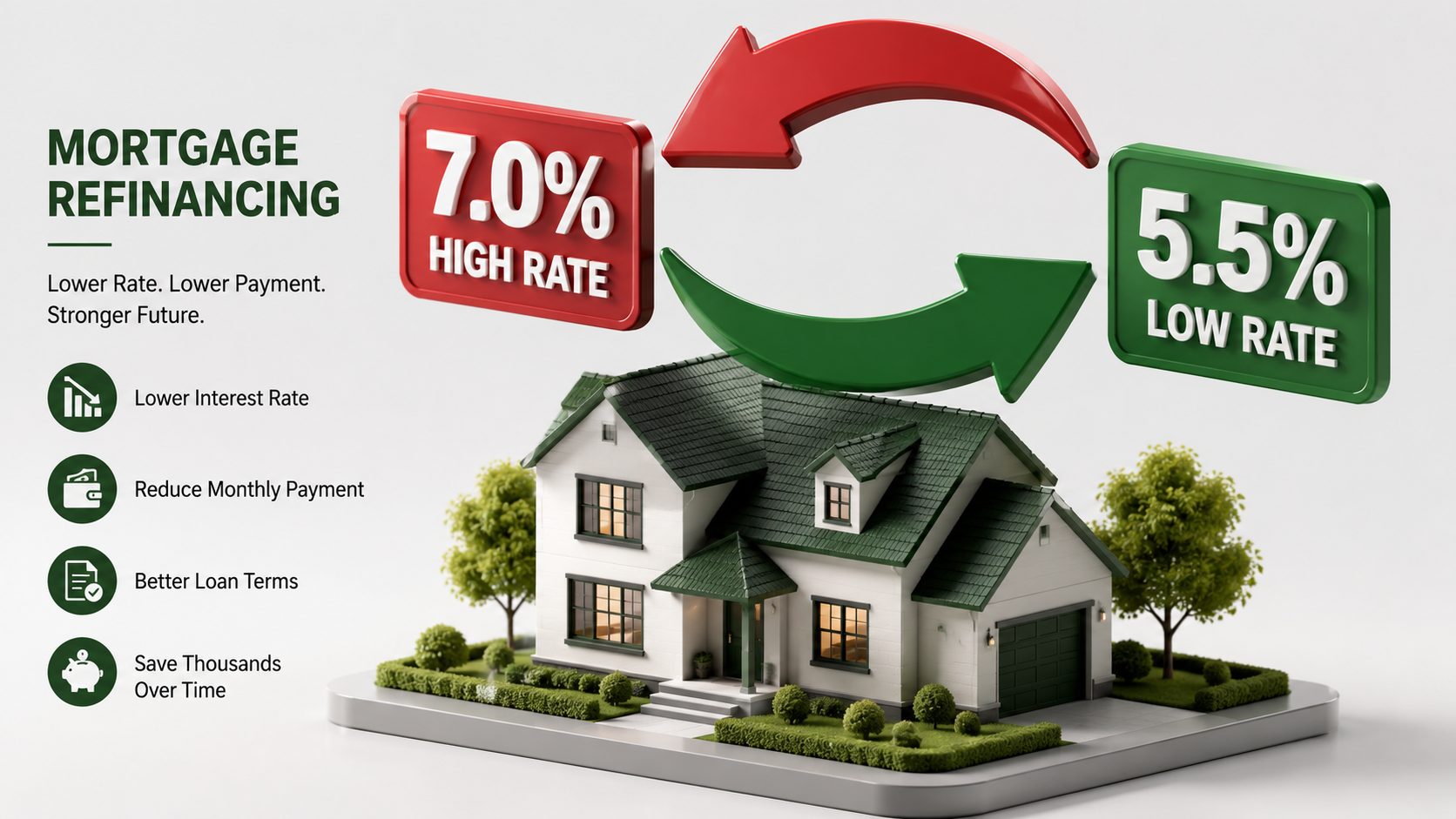
Let's analyze David and Clara, who bought a home in Denver with a 30-year fixed mortgage of $400,000 at 7.0% interest in 2024. Their monthly principal and interest payment is $2,661.21.
In 2026, after paying down their balance to $390,000, interest rates drop. They get an offer to refinance into a new 30-year fixed mortgage at 5.5% interest. The lender quotes $7,800 in total closing costs:
Let's calculate David and Clara's refinancing math:
Step 1: Calculate the New Monthly Payment
- Current Balance: $390,000
- New Interest Rate: 5.5% (30-year term)
- New Monthly Payment: $2,214.37
Step 2: Calculate Monthly Savings
- Old Payment: $2,661.21
- New Payment: $2,214.37
- Monthly Payment Savings = $2,661.21 - $2,214.37 = $446.84
David & Clara: 7.0% vs 5.5% on $390,000
Step 3: Calculate the Break-Even Point
- Total Closing Costs: $7,800
- Monthly Savings: $446.84
- Break-Even Months = Total Closing Costs ÷ Monthly Savings = $7,800 ÷ $446.84 = 17.5 Months
Verdict: David and Clara will break even in 18 months (1.5 years). Since they plan to live in the home for at least another five years, refinancing is a highly profitable move, saving them over $17,000 in net interest expenses over that period.
The Resetting-the-Clock Pitfall
One common mistake when refinancing is resetting your loan term. If you have already paid off 10 years of a 30-year mortgage, and you refinance into a new 30-year mortgage, you will extend your total repayment timeline to 40 years.
Even if your monthly payment drops, the extra 10 years of interest payments can cost you more in the long run. To avoid this:
- Refinance into a 20-year or 15-year fixed loan to match your original timeline.
- Ask your lender for a custom loan term (e.g. a 20-year term) to keep you on track.
- Make extra principal payments on your new loan to match your original payoff date.
Use the Mortgage Refinancing Calculator to model your current mortgage details, input new rates, and view your custom amortization break-even chart.
Advanced Strategic Implementation & Optimization for Refinancing
Refinancing a mortgage requires calculating closing costs, interest rate differentials, and the break-even timeline.
Mortgage Refinancing Checklist
- Calculate the Break-Even Point: Divide your total refinancing closing costs by your monthly interest savings.
- Audit Closing Fees: Look out for appraisal fees, title search fees, origination charges, and early exit penalties on your current loan.
- Verify Debt Service Ratios: Ensure your GDS and TDS ratios comply with lending standards under current stress-test rates.
Step-by-Step Refinancing Analysis
- Obtain Current Loan Details: Retrieve your mortgage statement showing the remaining balance, term, and interest rate.
- Request Bank Term Sheets: Gather interest rate quotes and upfront closing fee estimates from multiple lenders.
- Compute Monthly Savings: Calculate the difference in monthly interest payments between the two options.
- Determine the Break-Even Month: Divide total fees by monthly savings. If you plan to stay in the home longer than this period, refinance.
Common Pitfalls & Audit Warnings
- Ignoring Early Break-Fees: Forgetting to account for prepayment penalties (which can equal 3 months of interest or the interest rate differential) can wipe out refinancing savings.
- Extending the Loan Term: Refinancing a loan with 15 years remaining back into a 30-year term increases the total lifetime interest paid.
- Neglecting the Appraisal Value: Assuming your property value is high enough to avoid PMI or CMHC fees on the new mortgage without a fresh appraisal.
Advanced Loan Repayment & Amortization Scenario Modeling
We analyze three refinancing scenarios to demonstrate the impact of interest rates and closing fees.
Refinancing Scenario Table
| Metric | Scenario A: Rate Drop | Scenario B: Shortened Term | Scenario C: High Fees |
|---|---|---|---|
| Loan Balance | $350,000 | $350,000 | $350,000 |
| Original Interest Rate | 6.5% | 6.5% | 6.5% |
| New Interest Rate | 5.25% | 4.85% (15-Year) | 5.75% |
| Refinancing Fees | $4,500 | $4,500 | $8,500 |
| Monthly Savings | $285 | $650 (Total Interest) | $160 |
| Break-Even Month | 16 Months | 7 Months | 53 Months (Avoid) |
Break-even month across three refinance offers
Step-by-Step Calculation Walkthrough
Scenario A: Standard Refinance (16-Month Break-Even)
- Monthly Interest Savings: The interest payment drops from $1,895 to $1,610, saving $285 monthly.
- Refinancing Fees: Origination, title, and appraisal fees sum to $4,500.
- Break-Even Math: $4,500 / $285 = 15.8 months.
4. The Break-Even Calculation: Exactly When Refinancing Pays Off
Refinancing a mortgage isn't free. It involves closing costs, appraisal fees, title insurance, and origination charges that typically range between 2% and 5% of the total loan amount. To determine if refinancing is actually worth it, you must calculate your "break-even point" — the exact number of months it will take for your monthly savings to cover the upfront costs.
The Break-Even Formula
Let's look at a real-world scenario:
- Current Loan: $300,000 balance at 6.5% interest (Monthly P&I payment: $1,896)
- New Refinanced Loan: $300,000 balance at 5.5% interest (Monthly P&I payment: $1,703)
- Upfront Refinancing Fees (Closing Costs): $6,000
The Calculation
- Calculate Monthly Savings: $1,896 - $1,703 = $193 per month.
- Apply the Formula: $6,000 ÷ $193 = 31.1 months.
The break-even formula on a $300,000 loan
In this scenario, it will take you approximately 31 months (about 2.5 years) to break even. If you plan to sell the home or move in under 2 years, refinancing will result in a net financial loss. If you plan to stay in the home for 5+ years, refinancing is a highly profitable move that saves you over $55,000 in total interest over the life of the loan.
5. Cash-Out Refinance vs. HELOC: Which is Lower Risk?
When you have significant home equity, you can access it to fund home renovations, consolidate high-interest debt, or pay for education. The two most common options are a cash-out refinance and a Home Equity Line of Credit (HELOC).
- Cash-Out Refinance: You replace your existing mortgage with a new, larger mortgage. You receive the difference in cash, and you pay off the new loan at a fixed interest rate.
- HELOC: A second mortgage that functions like a credit card secured by your home. You can draw from the line of credit as needed during the "draw period" (usually 10 years), and you pay a variable interest rate on what you borrow.
The Recommendation
- Choose a HELOC if you have a low interest rate on your primary mortgage, as a cash-out refinance would force you to refinance your entire mortgage at a potentially higher current rate.
- Choose a Cash-Out Refinance if interest rates are low and you want the stability of a fixed monthly payment.
6. How the 'No-Closing-Cost' Refinance Option Works
Lenders often advertise "no-closing-cost" refinancing options, which appeal to homeowners who do not want to pay thousands of dollars in fees upfront.
In a no-closing-cost refinance, the lender covers the closing fees (appraisal, title search, administration) but offsets their cost by charging you a slightly higher interest rate (typically 0.25% to 0.50% higher) or by rolling the closing costs into your total loan balance. While this option eliminates the upfront cash barrier, it increases your monthly payments and reduces your long-term interest savings, so always calculate the total cost over the life of the loan.