How Does the Debt Snowball Compare to the Debt Avalanche in a Real-World Scenario?
To understand the practical differences between the Debt Snowball and Debt Avalanche methods, you must analyze a detailed mathematical case study: by tracking the exact monthly payments, interest accrual, and payoff schedules of a real debtor under both systems, you can quantify the precise dollar savings and time difference. This case study breaks down the math of a typical debt profile to show you which strategy wins.
Quick Answer Summary
- The Profile: Maya has $15,000 in debt split across a medical bill, a car loan, and a high-interest credit card. Her monthly debt budget is $800.
- The Snowball Result: Maya becomes debt-free in 23 months and pays a total of $1,980 in interest. Her first account is paid off in Month 3.
- The Avalanche Result: Maya becomes debt-free in 19 months and pays a total of $560 in interest. Her first account is paid off in Month 11.
- The Verdict: The Debt Avalanche saved Maya $1,420 in cash and got her debt-free 4 months faster than the Debt Snowball.
Total interest paid: snowball vs avalanche
Maya's Debt Profile: The Inputs
Maya's outstanding debts are structured as follows:
- Debt 1 (Medical Bill): $1,200 balance | 4% interest rate | $50 minimum monthly payment.
- Debt 2 (Car Loan): $7,800 balance | 6% interest rate | $180 minimum monthly payment.
- Debt 3 (Credit Card): $6,000 balance | 22% interest rate | $150 minimum monthly payment.
- Total Outstanding Debt: $15,000
- Sum of Minimum Payments: $380 ($50 + $180 + $150)
- Maya's Monthly Debt Budget: $800 (meaning she has $420 of extra cash to accelerate her payoff every month).
Maya's $15,000 debt profile
Strategy 1: The Debt Snowball Payoff Schedule
Under the Debt Snowball, Maya lists her debts by balance size, from smallest to largest:
- Medical Bill: $1,200 (Smallest)
- Credit Card: $6,000
- Car Loan: $7,800 (Largest)
The Payoff Timeline:
- Months 1 to 3: Maya pays the minimum on the Credit Card ($150) and Car Loan ($180). She directs her extra cash ($420 + $50 minimum = $470) to the Medical Bill.
- Result: The Medical Bill is completely paid off in Month 3. Maya gets her first quick win!
- Months 4 to 12: Maya now rolls the Medical Bill payment ($470) into the Credit Card, paying a total of $620 monthly ($470 + $150 minimum).
- Result: The Credit Card is paid off in Month 12.
- Months 13 to 23: Maya rolls the entire $800 budget ($620 + $180 minimum) into the Car Loan.
- Result: The Car Loan and all remaining debt are cleared in Month 23.
- Total Interest Paid (Snowball): $1,980
Strategy 2: The Debt Avalanche Payoff Schedule
Under the Debt Avalanche, Maya lists her debts by interest rate, from highest to lowest:
- Credit Card: 22% (Highest)
- Car Loan: 6%
- Medical Bill: 4% (Lowest)
The Payoff Timeline:
- Months 1 to 10: Maya pays the minimum on the Medical Bill ($50) and Car Loan ($180). She directs her extra cash ($420 + $150 minimum = $570) to the high-interest Credit Card.
- Result: The Credit Card is completely paid off in Month 10. Maya has to wait 10 months for her first win, but she has stopped the 22% interest leak!
- Months 11 to 18: Maya rolls the Credit Card payment ($570) into the Car Loan, paying a total of $750 monthly ($570 + $180 minimum).
- Result: The Car Loan is cleared in Month 18.
- Month 19: Maya rolls her full $800 budget into the remaining Medical Bill, clearing the balance instantly.
- Result: Maya is completely debt-free in Month 19.
- Total Interest Paid (Avalanche): $560
Side-by-Side Mathematical Comparison
Let's compare the final outcomes of Maya's debt path under both systems:
| Payoff Metric | Debt Snowball | Debt Avalanche | The Avalanche Difference |
|---|---|---|---|
| Time to First Win | 3 Months | 10 Months | -7 Months (Snowball wins) |
| Total Months to Debt-Free | 23 Months | 19 Months | 4 Months Faster |
| Interest Paid (Medical Bill) | $40 | $65 | +$25 |
| Interest Paid (Car Loan) | $810 | $410 | -$400 |
| Interest Paid (Credit Card) | $1,130 | $85 | -$1,045 |
| Total Interest Paid | $1,980 | $560 | $1,420 Saved |
Where the interest accrues under each method
Verdict: The Debt Avalanche saved Maya $1,420 in interest charges and cut 4 months off her repayment timeline. By targeting the 22% credit card first, she prevented massive interest accumulation, allowing more of her monthly $800 budget to reduce the principal balances.
Which Strategy Should You Choose?
Maya's case study highlights the classic personal finance trade-off:
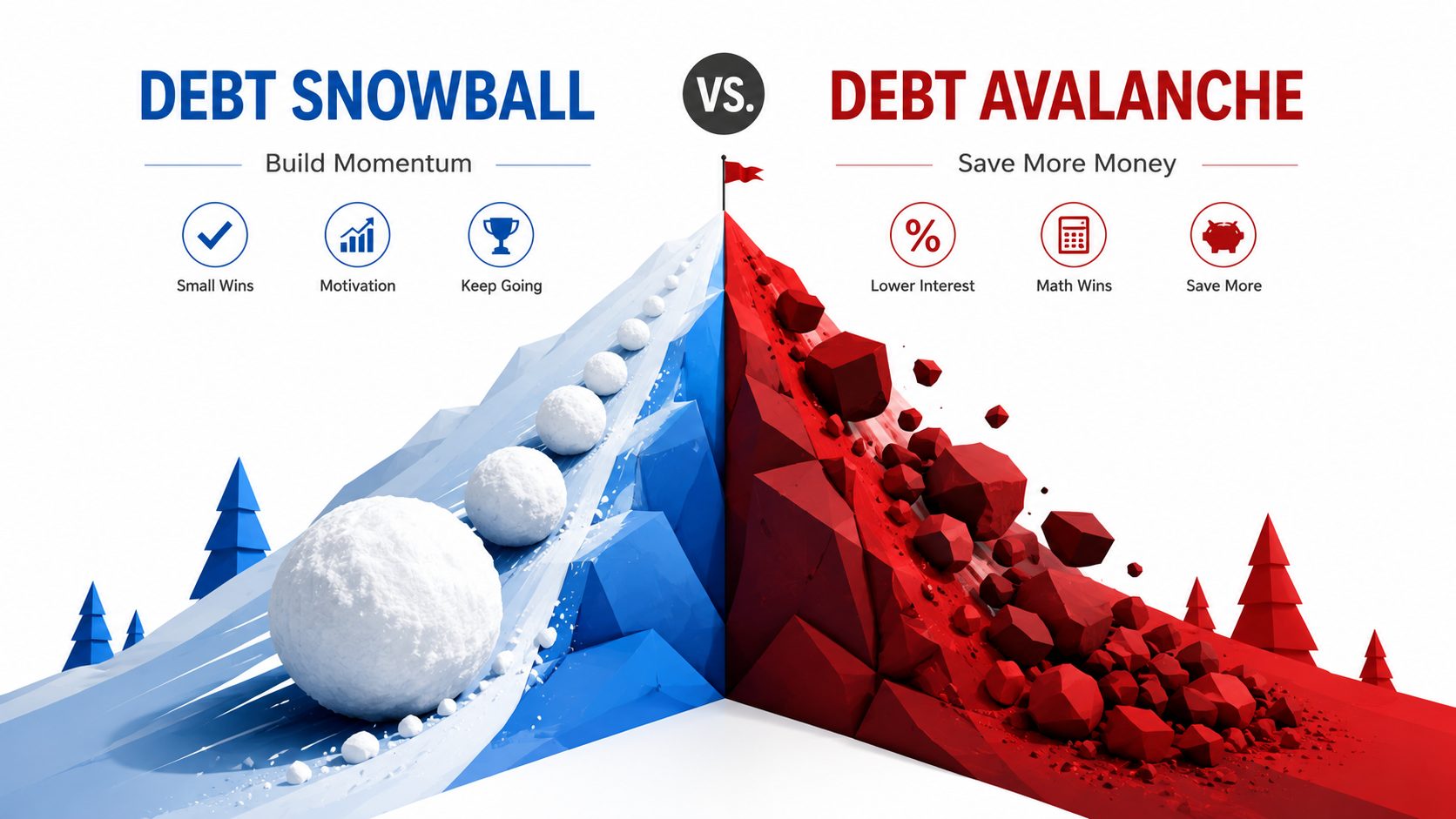
- Choose the Debt Snowball if: You struggle with consistency. If Maya had chosen the Avalanche but lost motivation and quit in Month 6 because she hadn't paid off any accounts yet, she would not have achieved debt freedom. The Snowball's Month 3 win is a powerful behavioral anchor.
- Choose the Debt Avalanche if: You are disciplined and hate paying interest. The math is clear: the Avalanche is the most efficient and cost-effective path to debt freedom.
Use the Debt Snowball vs Avalanche Calculator to plug in your own credit card, car loan, and student loan balances, and map out your custom payoff schedule.
Advanced Strategic Implementation & Optimization: Case Study Analysis
Analyzing debt repayment case studies reveals the mathematical and psychological trade-offs between different debt strategies.
Repayment Strategy Checklist
- Calculate Interest Savings: Use calculators to estimate the exact interest saved by choosing Avalanche over Snowball.
- Measure Emotional Momentum: Assess if quick wins (Snowball) are necessary to keep you motivated on your debt payoff path.
- Map Out the Timeline: Create a monthly repayment schedule showing when each account will reach a zero balance.
Step-by-Step Case Study Execution
- Map Your Debt Profile: List your debts (credit cards, personal loans, car loans) with exact interest rates and balances.
- Compare Monthly Projections: Run parallel simulations using both the Snowball and Avalanche algorithms.
- Select Your Plan: Commit to the strategy that maximizes your likelihood of completion.
- Track Milestones: Update your tracking spreadsheets monthly to celebrate each account paid off.
Common Pitfalls & Audit Warnings
- Changing Strategies Mid-stream: Switching between Snowball and Avalanche repeatedly slows down your overall repayment progress.
- Failing to Adjust Budget Slices: Neglecting to add the minimum payment of a paid-off account to the next target debt halts the snowball effect.
- Ignoring Credit Card Utilization: Keeping high balances on multiple cards can hurt your credit score even if you are actively paying down debt.
Advanced Loan Repayment & Amortization Scenario Modeling
We analyze the financial profiles of two borrowers, John and Lisa, utilizing different repayment strategies on identical debt loads.
Case Study Comparison Table
| Metric | John: Debt Snowball | Lisa: Debt Avalanche | Difference / Savings |
|---|---|---|---|
| Total Debt Load | $30,000 | $30,000 | Identical starting point |
| Monthly Budget | $1,200 | $1,200 | Identical repayment power |
| Total Interest Cost | $6,120 | $4,980 | $1,140 Saved by Lisa |
| Payoff Timeline | 32 Months | 29 Months | 3 Months Faster for Lisa |
| Accounts Closed (Mo 6) | 3 Accounts | 1 Account | John wins on motivation |
Step-by-Step Repayment Timelines
John's Snowball Timeline (Behavioral Focus)
- Month 3: Pays off medical bill ($1,200 balance). Quick win achieved.
- Month 9: Pays off personal loan ($4,000 balance). Second account closed.
- Month 32: Pays off credit card ($24,800 balance). Debt-free.
4. What About Debt Consolidation? When to Use It Instead
If you have multiple high-interest credit card debts, executing a Snowball or Avalanche plan can be logistically challenging. Debt Consolidation involves taking out a single personal loan at a lower interest rate to pay off all your smaller debts, leaving you with just one monthly payment.
When to Consolidate
- Your credit score is high enough to qualify for an interest rate that is significantly lower than the average rate of your current debts (e.g., a 10% personal loan to pay off 24% credit cards).
- You have the discipline to stop charging new balances on the credit cards you just paid off. If you consolidate and then build up new balances, you will double your total debt load.
5. Psychological Wins: How to Stay Motivated on a 3-Year Payoff Plan
Paying off debt is a marathon, not a sprint. To stay motivated over a multi-year timeline:
- Track Visual Progress: Create a debt thermometer or coloring sheet to track your progress visually.
- Celebrate Milestones: Reward yourself (with low-cost rewards) when you pay off an account or reach a round number milestone (e.g., $10,000 paid off).
- Automate Your Budget: Set up automatic transfers to your target debt the day you get paid, removing the temptation to spend the extra cash.
6. How Your Payoff Plan Affects Your Mental Well-Being
Executing a long-term debt payoff plan is as much a psychological challenge as a financial one. Debt stress is linked to anxiety, sleep deprivation, and relationship tension.
By selecting the Debt Snowball, you focus on quick, actionable victories. Wiping out a small card balance of $250 within the first 30 days provides an immediate sense of control. This dopamine hit helps break the feeling of helplessness and builds the momentum needed to tackle larger balances. If you choose the Avalanche, recognize that the reward is delayed, and find non-monetary ways to reward your discipline.