How Do You Choose Between the Debt Snowball and Debt Avalanche Methods?
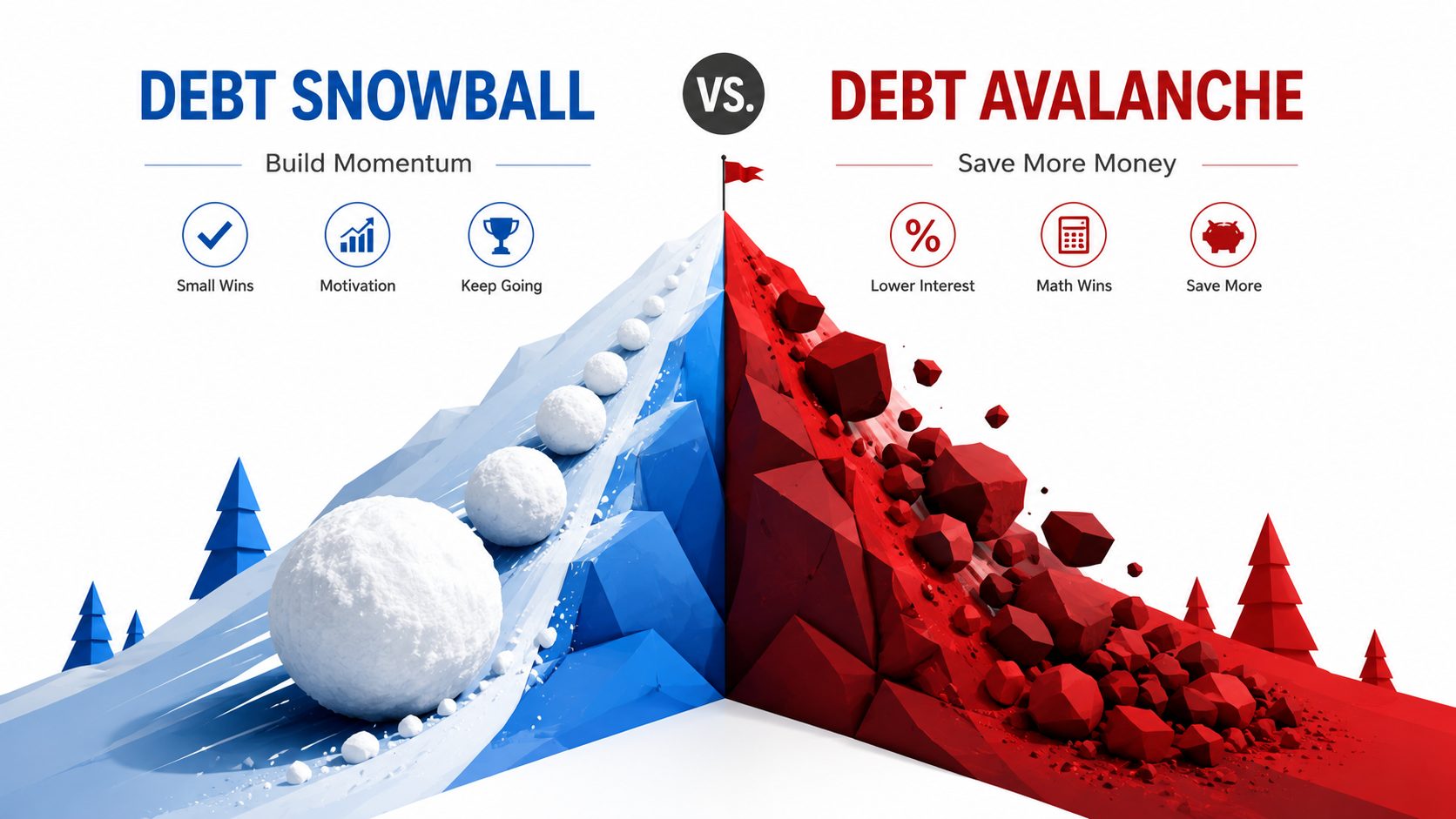
To choose between the Debt Snowball and Debt Avalanche methods, you must decide whether you prioritize psychological motivation or mathematical optimization: the Debt Snowball targets your smallest debt balances first to give you quick wins, whereas the Debt Avalanche targets your highest interest rate debts first to minimize interest fees and pay off your debt with the lowest overall cost.
Quick Answer Summary
- Debt Snowball: List debts from smallest balance to largest. Pay minimums on all, and put all extra cash toward the smallest balance. Once paid off, roll that payment into the next smallest. Focuses on behavior modification.
- Debt Avalanche: List debts from highest interest rate to lowest. Pay minimums on all, and put all extra cash toward the highest interest rate debt. Once paid off, roll that payment into the next highest interest rate. Focuses on interest savings.
- Which is Better?: Mathematically, the Avalanche is always superior. However, behavioral research shows that the Snowball's quick wins are highly effective at keeping people motivated, leading to higher long-term completion rates.
The Debt Snowball Method: How It Works
The Debt Snowball method, popularized by personal finance experts, focuses on psychology rather than math. Here is the step-by-step process:
- List all your debts (credit cards, student loans, car payments, personal loans) in order of balance size, from smallest to largest. Ignore the interest rates.
- Pay the minimum required payment on every debt except the smallest.
- Put any extra cash (from side hustles, budgeting cuts, bonuses) toward the smallest debt until it is completely paid off.
- When the smallest debt is gone, take the entire amount you were paying toward it (its minimum payment plus any extra cash) and add it to the minimum payment of the next smallest debt.
- Repeat this process, creating a "snowball" effect as your payments grow larger with each debt you eliminate.
The Debt Avalanche Method: How It Works
The Debt Avalanche method is the mathematically optimal path to debt freedom. Here is the step-by-step process:
- List all your debts in order of interest rate, from highest to lowest. Ignore the balance size.
- Pay the minimum required payment on every debt except the one with the highest interest rate.
- Put any extra cash toward the highest interest rate debt until it is completely paid off.
- When that debt is gone, take the entire payment amount and direct it toward the next highest interest rate debt.
- Repeat this process until all debts are paid off.
Comparison: Snowball vs. Avalanche
To help you decide which approach fits your situation, let's compare their characteristics:
| Characteristic | Debt Snowball | Debt Avalanche |
|---|---|---|
| Primary Focus | Psychological motivation and momentum | Interest expense minimization |
| Order of Payoff | Smallest balance first | Highest interest rate first |
| Total Cost | Higher (you pay more interest overall) | Lower (you pay the absolute minimum interest) |
| Time to First Win | Fast (small debts are eliminated quickly) | Variable (depends on the size of the high-rate debt) |
| Best Suited For | Individuals who need quick wins to stay motivated | Individuals driven by math and analytical logic |
The Behavioral Science of Debt Payoff
Why does the Debt Snowball work so well if the math favors the Avalanche? Behavioral economists have researched this extensively:
- Progress Feedback: A study published in the Journal of Consumer Research found that eliminating a single debt account entirely (a "quick win") increases a consumer's motivation to pay off their remaining debts more than simply reducing balances across multiple accounts.
- Cognitive Load: Managing ten separate debt accounts is stressful. Reducing that number to seven quickly reduces cognitive load and financial anxiety, making the path feel manageable.
- Momentum: Seeing an entire credit card balance hit $0 provides a dopamine boost that reinforces the habit of saving and paying down debt.
Choosing the Right Strategy for Your Debts
If you have a mix of low-interest student loans and high-interest credit card debt, here is how you should decide:
- Default to Avalanche if: You have high-interest debt (e.g. credit cards at 18% to 28% interest). Leaving these active while paying off a low-interest 4% car loan will cost you thousands of dollars in unnecessary interest fees.
- Default to Snowball if: You have several small, miscellaneous debts (medical bills, store cards, personal loans under $1,000) that can be eliminated in 3 to 6 months. Getting these out of the way simplifies your life and clears the path for larger payoffs.
Use the Debt Snowball vs Avalanche Calculator to input your specific balances and rates, and see a side-by-side projection of your payoff timeline and interest savings.
Advanced Strategic Implementation & Optimization for Debt Repayment
Eradicating personal debt requires selecting the repayment methodology that aligns with your behavioral psychology and financial structure.
Debt Eradication Checklist
- Audit All Debt Balances: List every outstanding liability along with its interest rate and minimum payment.
- Freeze New Borrowing: Cut up credit cards and stop taking out consumer loans during the repayment process.
- Automate Minimum Payments: Set up auto-debit rules to avoid missing deadlines and damaging your credit score.
Step-by-Step Debt Repayment Plan
- Choose Your Methodology: Select the Debt Snowball (organizing by smallest balance) or Debt Avalanche (organizing by highest interest rate).
- Fund a Starter Emergency Reserve: Save $1,000 to $2,000 as a buffer against emergency costs.
- Pay the Minimums: Automate the minimum monthly payments on all accounts except the target debt.
- Inject Extra Cash: Direct all spare income, side-hustle earnings, and bonuses to pay down the target debt.
Common Pitfalls & Audit Warnings
- Ignoring Interest Rates in Avalanche: Attempting the Avalanche method but losing momentum because the largest interest rate account has a huge balance.
- Depleting Your Emergency Savings: Directing every dollar of cash to debt repayment without maintaining a starter emergency fund can force you back into debt.
- Consolidating Debt Into Worse Terms: Taking out a consolidation loan that extends the repayment term and increases overall interest cost.
Advanced Loan Repayment & Amortization Scenario Modeling
We compare the repayment math for a borrower holding $25,000 in credit cards and student loans.
Repayment Strategy Comparison Table
| Metric | Strategy A: Minimums Only | Strategy B: Debt Snowball | Strategy C: Debt Avalanche |
|---|---|---|---|
| Monthly Payment | $450 (Variable) | $900 | $900 |
| Payoff Order | N/A | Smallest Balance First | Highest Interest First |
| Total Interest Paid | $12,450 | $4,850 | $3,920 |
| Time to Debt-Free | 11.5 Years | 3.2 Years | 2.9 Years |
$25,000 of debt: total interest by strategy
| Psychological Win | Low | High (Quick Wins) | Moderate |
|---|
Step-by-Step Repayment Flow
Strategy C: Debt Avalanche (High Interest Focus)
- Action: Target the credit card ($5,000 at 22% interest) first, paying minimums on student loans.
- Saves Cash: Bypasses the high-interest accumulation, saving $930 in interest compared to Snowball.
- Speed: Achieves full debt-freedom three months faster.
4. What if You Have Both High-Interest and Emotional Debt? The Hybrid Payoff Method
While the Debt Snowball targets psychological momentum and the Debt Avalanche minimizes interest costs, many people find themselves torn between these two methodologies. If you have a massive credit card balance at 24% interest and a small medical bill of $300 at 0% interest, neither method feels completely optimal.
Enter the Hybrid Debt Payoff Method, which seeks to balance mathematical efficiency with emotional wins.
How to Structure a Hybrid Plan
- Identify the 'Emergency' Debts: Group any debts with interest rates exceeding 15% (typically credit cards and payday loans). These are high-risk financial emergency items.
- Order by Rate first: List these high-interest debts in order of interest rate, and use the Avalanche method to aggressively wipe them out first. This protects your cash flow from compound drain.
- Sort the Rest by Balance: Once the high-interest debt is cleared, sort the remaining low-interest debts (student loans, car loans, medical bills) by balance size. Use the Snowball method to pay off the smallest balances first to gain quick psychological wins.
This ensures you don't waste thousands of dollars paying off 24% interest debt last, but still gives you the emotional relief of crossing smaller accounts off your list once the immediate emergency has passed.
5. How Does Debt Payoff Affect Your Credit Score and Timeline?
Paying off debt is one of the most powerful drivers of your credit score, but the trajectory isn't always a straight line. Understanding how the credit bureaus view your debt payoff path helps prevent surprises.
The Credit Utilization Ratio
Your credit card utilization ratio accounts for 30% of your FICO score. It is calculated as your total revolving debt divided by your total credit limits.
- The Golden Rule: Keep utilization below 30%, and ideally below 10% for the best score.
- The Payoff Impact: As you execute your Snowball or Avalanche plan, your utilization ratio drops, often resulting in double-digit credit score increases within 30 to 60 days of a major balance payoff.
Closing Accounts After Payoff: The Hidden Trap
When you pay off a credit card, it is tempting to close the account immediately. However, closing an account reduces your total available credit limit (which raises your utilization ratio) and will eventually shorten your average credit history length. Keep the account open with a zero balance, and charge a small recurring subscription to it once a year to keep it active.
6. A Real-World Math Comparison: Payoff Timeline for a £15,000 Debt Portfolio
To see the real-world difference between Snowball and Avalanche, let's examine a sample debt portfolio with an extra £500 per month budget allocation:
- Debt A (Credit Card): £4,000 balance at 22% interest (Minimum payment: £100)
- Debt B (Personal Loan): £8,000 balance at 8% interest (Minimum payment: £200)
- Debt C (Store Card): £3,000 balance at 26% interest (Minimum payment: £80)
The Payoff Comparison
- Under the Avalanche Method: You target Debt C (26%), then Debt A (22%), then Debt B (8%). Total interest paid is approximately £1,420, and the debt-free date is reached in 22 months.
- Under the Snowball Method: You target Debt C (£3,000), then Debt A (£4,000), then Debt B (£8,000). Because the store card (smallest balance) also has the highest rate, the initial order matches. However, the interest difference is felt when targeting the personal loan vs. the credit card. Total interest paid is £1,650, and the debt-free date is reached in 23 months.
For this portfolio, the Avalanche method saves £230 and knocks 1 month off the timeline. The larger your debt portfolio and the wider the interest rate spread, the more significant the Avalanche savings become.
£15,000 portfolio: interest paid, snowball vs avalanche