A Thirteenth Paycheck for Swiss Retirees, Arriving Just Before Christmas
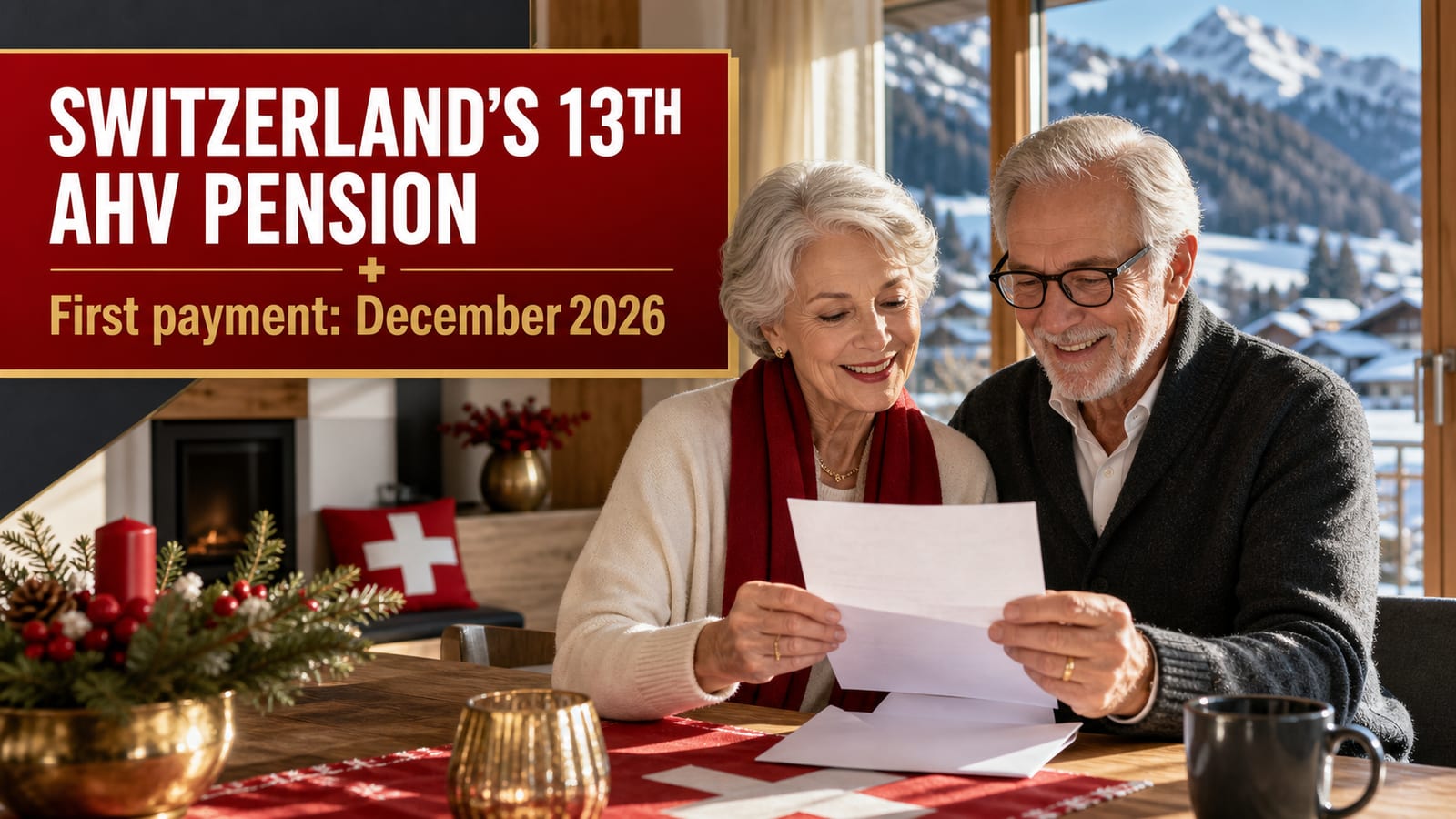
Switzerland will pay a 13th AHV pension for the first time in December 2026, an extra month's pension deposited automatically alongside the regular December payment. For the roughly 2.7 million people drawing an old-age pension from the AHV (the Swiss state pension, known as OASI in English), it is the most tangible change to the retirement system in a generation. If you receive a monthly AHV pension of CHF 2,000, you will get an additional CHF 2,000 in December, on top of your normal payment.
The 13th pension was approved by Swiss voters in a 2024 referendum and has now cleared parliament, with the Federal Council confirming the first payout for the end of 2026. It is structured simply: the extra payment equals one-twelfth of your annual old-age pension, which is the same as receiving one additional monthly pension. Think of it as a thirteenth salary for retirees, mirroring the thirteenth-month salary many Swiss employees receive.
But the simplicity hides a few wrinkles that matter for your household budget. Married couples face a combined ceiling that can trim the benefit. The extra payment is taxable income. And the whole scheme is being financed partly by a VAT increase that you will feel at the till. This guide explains exactly how the 13th AHV pension works, how to estimate yours, where the caps bite, and what it means for your tax bill.
Important
The first 13th AHV pension is paid automatically in December 2026. You do not need to apply or take any action. The figures below use the 2026 maximum individual pension of CHF 2,520 per month. Confirm your personal amount against your annual AHV statement from your compensation office (Ausgleichskasse / caisse de compensation).
How the 13th AHV Pension Is Calculated
The formula is deliberately straightforward. Your 13th pension is one-twelfth of your annual AHV old-age pension. Since your annual pension is simply twelve times your monthly pension, the 13th payment works out to exactly one extra monthly pension.
Let's follow Ms. Keller, a retiree in Zurich, to see how the rounding works. Her annual AHV pension is CHF 15,200:
- One-twelfth : CHF 15,200 ÷ 12 = CHF 1,266.66
- Rounded to whole francs : CHF 1,267
- Payout : In December, Ms. Keller receives her normal monthly pension plus an extra CHF 1,267.
The rounding to whole francs is a small but real detail. The compensation offices round the one-twelfth figure, so your 13th payment may differ by a franc or two from a naive division of your monthly amount.
The 2026 Maximum: CHF 2,520 a Month
The AHV pension has a floor and a ceiling. For 2026, the maximum individual old-age pension is CHF 2,520 per month. The minimum full pension is CHF 1,260 per month. Where you land between those two depends on your average annual income over your working life and your contribution years.
That ceiling directly caps the 13th payment for a single person:
| Pensioner Type | Max Monthly Pension (2026) | Max 13th Payment | Max Annual Total (incl. 13th) |
|---|---|---|---|
| Single individual | CHF 2,520 | CHF 2,520 | CHF 32,760 |
| Married couple (combined cap) | CHF 3,780 (150%) | CHF 3,780 | CHF 49,140 |
For a single retiree at the maximum, the 13th pension adds CHF 2,520, bringing the annual total to CHF 32,760. For someone on the minimum full pension of CHF 1,260, the 13th payment is CHF 1,260.
Note
Your actual pension depends on your contribution record. The full pension requires a complete contribution history (44 years for the relevant scale). Gaps in contributions, common for people who arrived in Switzerland partway through their careers or took time out, reduce your pension proportionally. Your compensation office can provide a projection.
The Married-Couple Cap (Plafonierung): Where the 13th Payment Gets Trimmed
Here is the wrinkle that catches many couples off guard. AHV pensions for married couples are capped at 150% of the maximum individual pension. This rule, called Plafonierung, applies to the couple's combined monthly pension, and it applies to the 13th payment too.
The maximum combined pension for a married couple in 2026 is therefore:
Consider Hans and Beatrice, both retired, both entitled to the maximum individual pension of CHF 2,520. Naively, you might expect them to receive CHF 5,040 combined. They do not. The plafonierung caps their combined monthly pension at CHF 3,780.
- Without the cap : CHF 2,520 + CHF 2,520 = CHF 5,040
- With the 150% cap : CHF 3,780 combined
- Amount lost to the cap : CHF 1,260 per month
The married-couple cap trims the 13th payment
Their 13th pension is calculated on the capped amount, so their combined 13th payment is CHF 3,780, not CHF 5,040. Over the year, the couple receives CHF 3,780 × 13 = CHF 49,140.
This cap is one of the most misunderstood features of the Swiss state pension. Two high-earning spouses do not simply double their individual entitlements. If you are a married couple planning retirement income, model the combined cap, not two separate maximums. Our 13th AHV Pension Calculator 2026 handles the plafonierung automatically when you enter both spouses' pensions.
Contribution Gaps and Scale 44: Why Your 13th Payment May Be Smaller
The 13th pension is proportional to your regular pension, so anything that reduces your regular pension reduces your 13th payment by the same fraction. The most common reducer is an incomplete contribution record.
Switzerland calculates your AHV pension using a contribution scale. A full pension requires a complete contribution history, referenced to Scale 44 (44 contribution years for the relevant cohort). If you have fewer than the full number of contribution years, your pension is reduced proportionally:
Take Elena, who moved to Switzerland at age 30 and will have 35 contribution years at retirement instead of the full 44. If the full pension on her income would be CHF 2,200:
- Reduction factor : 35 ÷ 44 = 0.795
- Elena's actual monthly pension : CHF 1,750
- Elena's 13th payment : CHF 1,750
Contribution years decide your 13th payment
This is especially relevant for the large expat community in Switzerland. If you arrived as an adult, you almost certainly have a contribution gap, and your 13th pension will reflect it. You can close some gaps by making back-payments within a five-year window, but only for periods after you became subject to AHV contributions.
The Tax Catch: The 13th Pension Is Taxable Income
There is no such thing as a tax-free AHV pension in Switzerland, and the 13th payment is no exception. AHV pensions are fully taxable as income at the federal, cantonal, and communal levels. The 13th pension is added to your taxable income in the year you receive it, which for the first payment means your 2026 tax return.
This matters for two reasons. First, it pushes your taxable income up in December, which can nudge you into a higher marginal bracket for the year depending on your canton. Second, because Swiss tax rates vary dramatically by canton and commune, the after-tax value of your 13th pension depends heavily on where you live.
Consider a retiree receiving a CHF 2,520 13th payment:
| Canton | Approx. Marginal Rate on Pension | Tax on CHF 2,520 | After-Tax 13th Payment |
|---|---|---|---|
| Zug (low-tax) | ~12% | ~CHF 302 | ~CHF 2,218 |
| Zurich (mid-tax) | ~22% | ~CHF 554 | ~CHF 1,966 |
| Geneva (high-tax) | ~30% | ~CHF 756 | ~CHF 1,764 |
After-tax value of a CHF 2,520 13th payment
These are illustrative marginal rates; your effective rate depends on your total income, deductions, and wealth. The point is that a CHF 2,520 headline 13th payment can be worth CHF 500 to CHF 750 less after tax depending on your address. If you are deciding where to retire in Switzerland, the cantonal tax difference on pension income is substantial. For a deeper look at how location shapes your Swiss tax bill, see our Swiss Three-Pillar Pension System Guide.
Tip
Because the 13th pension increases your taxable income, it can also affect means-tested benefits like premium subsidies for health insurance (Prämienverbilligung). If you receive such subsidies, factor the extra income into your eligibility estimate for 2026.
How the 13th Pension Is Funded: The VAT Connection
A thirteenth month of pensions does not appear from nowhere. The AHV fund is paying out roughly CHF 4.2 billion extra in 2026, rising to about CHF 5 billion in subsequent years as the pensioner population grows. To finance this, the Swiss Parliament approved an increase to the value-added tax (VAT), but the final decision hinges on a nationwide public referendum scheduled for November 2026.
The funding mechanism is a reminder that the 13th pension is a redistribution within the Swiss social insurance system, not free money. Current workers and consumers are effectively funding current retirees' extra month through higher VAT and a portion of federal tax revenue. For retirees, the practical implication is that the cost of living rises slightly via VAT at the same time the extra pension arrives, partially offsetting the benefit in real terms.
Who Gets the 13th Pension, and Who Does Not?
The 13th payment goes to everyone entitled to an AHV old-age pension. But there are edge cases worth understanding.
Eligible
- All recipients of an AHV old-age pension (Altersrente), including those who deferred their pension.
- Swiss citizens and foreign nationals who qualified for an AHV pension through contributions.
- Retirees living abroad who receive an AHV pension (subject to any social security agreement with their country of residence).
Special Cases
- Survivors' pensions (Witwen-/Witwerrente, orphan's pensions): Widows, widowers, and orphans do NOT receive the 13th pension. They continue to receive strictly 12 payments a year. (The only exception is when a survivor reaches statutory retirement age and their entitlement converts into a standard old-age pension).
- Disability pensions (IV/DI): The 13th pension is an old-age pension measure. Disability pension recipients transition to old-age pensions at retirement age, at which point the 13th payment applies.
- Death in December: If a pensioner dies at any point during December, the full 13th pension is legally owed and paid into the deceased's estate. (If they die in November or earlier, no 13th payment is made).
A Worked Household Example: Putting It All Together
Let's build a complete picture for Marco and Lucia, a married couple in St. Gallen, both retired in 2026.
- Marco's individual AHV pension (uncapped) : CHF 2,400/month
- Lucia's individual AHV pension (uncapped) : CHF 1,900/month
- Combined uncapped : CHF 4,300/month
Step 1: Apply the Married-Couple Cap
The couple cap is CHF 3,780 (150% of CHF 2,520). Their combined CHF 4,300 exceeds the cap, so their pension is reduced to CHF 3,780 per month.
Step 2: Calculate the 13th Payment
Their 13th payment equals one month of their capped pension: CHF 3,780.
Step 3: Annual Total
- Regular annual pension : CHF 3,780 × 12 = CHF 45,360
- Plus 13th payment : + CHF 3,780
- Total 2026 AHV income : CHF 49,140
Step 4: Estimate the Tax
At an illustrative combined marginal rate of 18% in St. Gallen, the tax on the CHF 3,780 13th payment is roughly CHF 680, leaving an after-tax 13th payment of about CHF 3,100.
Marco and Lucia's experience illustrates the three forces at work: the generous headline (an extra CHF 3,780), the married-couple cap that already trimmed their base pension, and the tax that takes a further slice. Use our 13th AHV Pension Calculator 2026 to run your own numbers, including the cap and a cantonal tax estimate.
How the 13th AHV Pension Fits Into the Three-Pillar System
The 13th payment only touches Pillar 1, the state AHV pension. It does not change your Pillar 2 occupational pension (BVG/Pensionskasse) or your Pillar 3a private savings. If you are still working, the 13th pension is a future benefit you are building toward; if you are retired, it is a pure top-up on the state portion of your income.
For anyone planning their overall Swiss retirement, the 13th pension slightly reduces the income gap that Pillars 2 and 3 are designed to fill, but only marginally. The AHV maximum of CHF 2,520 a month (CHF 32,760 a year with the 13th payment) is well below what most people need to maintain their pre-retirement standard of living. The three-pillar logic, state for basic needs, occupational for income replacement, private for the gap, remains intact. Our Pillar 3a Retroactive Buy-In Guide shows how to use the private pillar to close the remaining gap with tax-deductible contributions.
The Bottom Line
The 13th AHV pension is the most welcome change to Swiss retirement income in years, and its December 2026 arrival is something every pensioner can look forward to. The mechanics are simple: one extra monthly payment, paid automatically, equal to one-twelfth of your annual pension. But the real number that lands in your account is shaped by three forces you should understand before you spend it. The married-couple cap trims the benefit for dual-pension households. Contribution gaps shrink it for anyone without a full Swiss work history. And the taxman takes a slice that varies sharply depending on which canton you call home. Estimate your personal figure with the cap and your cantonal rate in mind, and the 13th pension becomes exactly what it was meant to be, a meaningful, predictable boost to your retirement.