Calculator
13th AHV Pension Payout Estimator (Switzerland)
Estimate your December 2026 13th AHV/OASI pension windfall payout, single vs. couple caps, and Scale 44 contribution rate.
Try it nowCalculate Swiss tax savings from retroactive Pillar 3a catch-up contributions. Model buy-in caps under new 2026 retirement rules.
Calculate your tax savings and pension growth under Switzerland's new 2026 rule allowing retroactive buy-ins for missed Pillar 3a contributions.
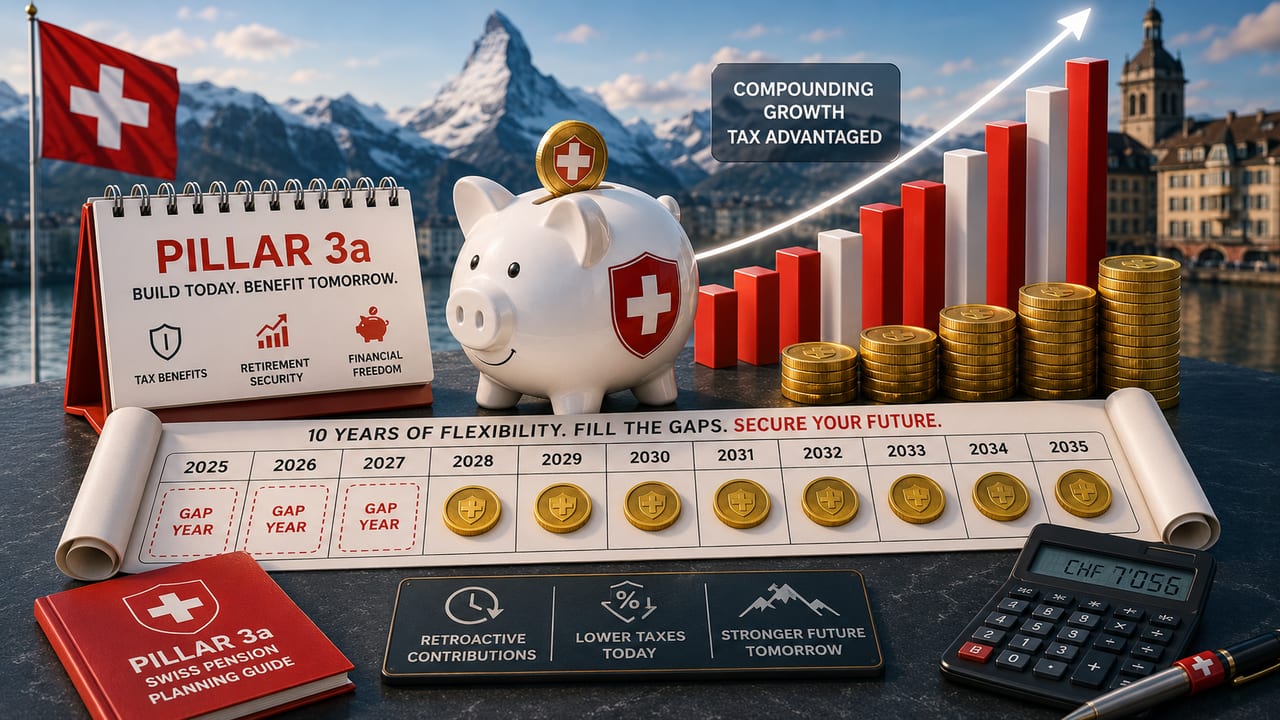
Effective from the 2026 tax year, Swiss residents can retroactively pay missing contributions into their Pillar 3a account to close past gaps. Gaps can be closed up to 10 years back, but only for years from January 1, 2025, onwards. Gaps arising before 2025 cannot be filled retroactively under the new legislation.
To make retroactive buy-ins, you must: (1) fully pay the maximum regular Pillar 3a contribution for the current tax year first, (2) have earned income subject to OASI/AHV both in the year the gap occurred and in the year the buy-in is made, and (3) limit the total retroactive buy-in amount in a single year to the current annual maximum cap (e.g. CHF 7,258 in 2026).
The mechanics matter more in year one than they ever will again. Your 3a provider must record a buy-in separately from the standard contribution, most banks and app providers added a dedicated buy-in flow for 2026, and the resulting attestation shows the two amounts on separate lines for the tax return. Keep the gap-year evidence with it: a salary certificate or tax assessment proving AHV-income in 2025, and the prior year's 3a statement showing the shortfall. Cantonal software accepts the combined deduction, but assessors are checking first-year claims closely, and a clean documentation trail converts a query letter into a non-event. One practical tip for holders of multiple 3a accounts: route the buy-in into whichever account you plan to withdraw LAST, since the staggered-withdrawal strategy at retirement works best when newer money sits in the later-opened pots.
The reform's most misunderstood fact is its start date. 'Ten years back' is true only once ten qualifying years exist: in 2026 the only fillable gap year is 2025; by 2030 you can reach back to 2025-2029; the full ten-year window matures in 2035. Anyone hoping to repair a decade of missed contributions from their twenties is out of luck, and any adviser suggesting otherwise is selling.
What the rule REALLY changes is the cost of a bad year going forward. Before, a maternity year, a startup year, or a sabbatical meant that year's 3a room died on 31 December. Now it survives a decade, which converts 'max your 3a every single year' from an iron rule into a flexible one, provided you eventually have the income to catch up, and provided you remember the entry ticket: the current year must be maxed before any buy-in counts.
A buy-in year is the rare chance to push twice the normal amount through the 3a deduction. At Nadia's 28% marginal rate the double contribution saves CHF 4,064 in one tax year; in high-tax cantons the same move at a 35-40% marginal rate clears CHF 5,000-5,800. The deduction lands against your top rate, so buy-ins are most valuable in your highest-income years, which conveniently is exactly when you can afford them.
That creates a genuine timing strategy: if you carry gap room and expect a bonus-heavy or promotion year, spend the buy-in there rather than in a lean year. Gap room does not expire for a decade, and a deduction placed against a 35% marginal rate beats the same deduction against 25% by CHF 726 per CHF 7,258, free money for choosing the right year.
Eligibility in the GAP year matters, not just today: you must have had AHV-taxable income in the year the gap arose. A year spent abroad or fully out of the workforce creates no fillable room, the reform rewards under-contributing workers, not non-workers. Cross-border commuters and returning expats should check each year individually.
Partial fills are final. If your 2025 gap is CHF 7,258 and you buy back CHF 4,000 of it, the remaining CHF 3,258 cannot be claimed later, the year is considered dealt with. Fill a given year's gap completely or deliberately leave it whole for a better tax year; half-measures burn room permanently, and the calculator's gap output is sized around exactly that all-or-nothing rule.
And the old multi-account wisdom still applies on the way out: 3a balances are taxed at withdrawal, progressively, so spreading savings, buy-ins included, across two or three accounts lets you stagger withdrawals across tax years in retirement. The buy-in reform changed how money gets IN; the exit planning that saves the second round of tax is unchanged and worth setting up before the balances grow large. The two strategies compound: buy-ins maximise the deduction going in, staggered accounts minimise the tax coming out, and a saver who does both captures tax relief at both ends of the same franc.
Since 1 January 2026, Switzerland lets you fill pillar 3a contribution gaps retroactively, and every franc of buy-in deducts from taxable income exactly like a normal contribution. The catch that headlines skip: only gaps arising from 2025 ONWARD count. The empty 3a years from your studies or your first job before 2025 are gone forever; the reform opens a window forward, not backward.
The calculator checks eligibility (current-year maximum paid first, AHV-income in the gap year), sizes the allowed buy-in against the small limit (CHF 7,258 in 2026), and prices the combined deduction at your marginal rate.
Nadia took an unpaid sabbatical in 2025 and contributed nothing to her 3a that year, leaving a CHF 7,258 gap.
In 2026, back at work in Zug, she first pays the full 2026 maximum of CHF 7,258, the mandatory entry ticket.
She then buys in CHF 7,258 against the 2025 gap: total deductible contributions of CHF 14,516 this year.
At her 28% marginal rate the tax saving is about CHF 4,064, roughly double a normal year's 3a benefit.
Had her gap been from 2024, none of this would apply, pre-2025 shortfalls are permanently unfillable, which is exactly why the discipline of maxing every year from now on got more valuable, not less.
Review the glossary of terms used in the calculation model below. Click on highlighted links to read more in-depth definitions in our financial glossary:
| Parameter | Definition & Context |
|---|---|
| Contribution Gap | Shortfalls versus the annual maximum for years from 2025 onward in which you had AHV-taxable income. Earlier years never qualify. |
| Retroactive Buy-In | This year's catch-up payment against that gap room, capped at the small limit (CHF 7,258 in 2026) per year. |
| Taxable Income | Drives your marginal rate, and for the self-employed without a pension fund, the 20%-of-income standard limit. |
The rules and figures on this page are researched from official primary sources: