Calculator
KVdR 9/10 Rule Eligibility Calculator
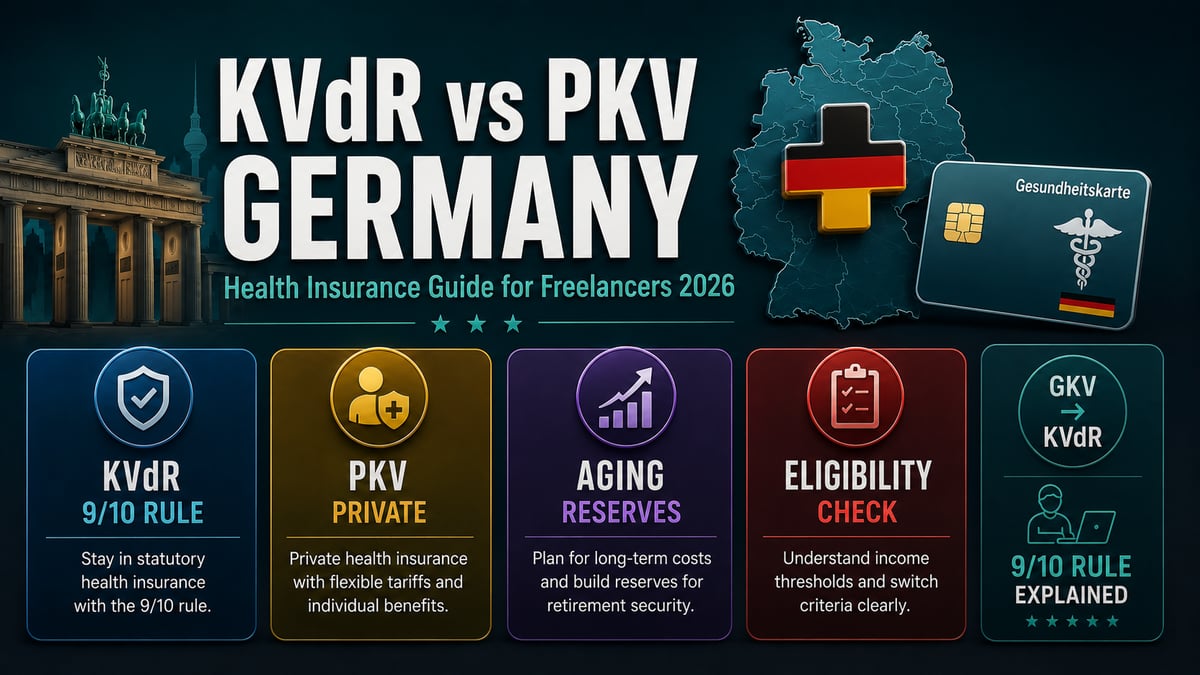
Calculate your Krankenversicherung der Rentner (KVdR) eligibility. Model GKV vs PKV years, check the 9/10 rule, and apply children's credits.
Try it nowCompare Germany's KVdR public pensioner insurance against private PKV: the 9/10 rule, contributions on rental income, and 10-year cost projections.
Adjust the variables below to simulate outcomes, compare rates, and see real-time projections.
A direct comparison of features, rules, limits, and eligibility requirements.
| Feature / Detail | KVdR (Public GKV Status) | PKV (Private Health Insurance) |
|---|---|---|
Contribution Basis in Retirement | Statutory pension only. Private pensions, rental income, dividends, and interest are completely contribution-free. | Fixed contract-based premium. Independent of your pension, private income, rental income, or capital gains. |
Pension Insurance Cost Share | The German statutory pension insurance (Rentenversicherung) pays 50% of the health insurance contribution (currently ~8.75% of your pension). | Retiree pays 100% of the private premium. You can apply for a tax-free subsidy from the pension insurance, but it is capped. |
Premium Cost Stability | High stability. Premiums are tied directly to your income. If your pension is low, your premiums drop accordingly. | Tariff-based risk. Premiums increase with medical inflation and age. Although aging reserves are built in, costs tend to rise. |
Family Coverage (Familienversicherung) | Free. Your spouse and children can be insured at no additional cost (subject to income limits). | Individual. Every family member must be insured under a separate contract and pays an individual premium. |
Medical Standard and Access | Statutory GKV standard. Covers all medically necessary treatments. Some treatments require co-payments (Zuzahlungen). | Premium private standard. Access to private rooms, top specialists, brand-name drugs, and faster appointment times. |
Entrance Requirements | Must satisfy the 9/10 rule: insured in public GKV for at least 90% of the second half of your working career. | No career timeline rules. Based on passing a medical health check and signing a contract during GKV-exemption eligibility. |
Aging Reserves (Altersrückstellungen) | None. Operating on a pay-as-you-go system where current workers fund the health costs of current retirees. | Yes. Part of your monthly premiums is saved and invested by the insurer to buffer cost increases in old age. |
Voluntary GKV Fallback (If 9/10 Rule Failed) | Applies general GKV rate of ~17.5% on ALL income sources (pension + rental + capital gains) up to the BBG cap of €5,812.50/month. | No fallback. Once in PKV past age 55, you are legally locked in and cannot return to GKV. |
Maximum Monthly Contribution (BBG Cap 2026) | €5,812.50/month Beitragsbemessungsgrenze. Even if you have high other income, GKV contributions are capped at this ceiling. | No cap on premium increases. Your PKV premium can theoretically rise without limit each year based on your tariff and age. |
Analyze the advantages and drawbacks of each financial product before making a decision.
Meet Stefan, 66: €1,500 of statutory pension, €800 a month from a rented flat. His health insurance bill depends entirely on which door he retires through: with the same income in all three cases.
Door one, KVdR: contributions are charged on the statutory pension only, at half the GKV rate (7.3% plus half the average 2.9% Zusatzbeitrag ≈ 8.75%). Stefan pays about €131 a month; his rental income is contribution-free. Door two, voluntary GKV (he failed the 9/10 rule): the full ~17.5% applies to ALL income, pension plus rent, costing about €403. Door three, PKV: his contract premium of €450, unrelated to income, and climbing every year.
Same person, same money: €131 versus €403 versus €450. Over a 20-year retirement, the gap between the best and worst door exceeds €75,000 before PKV increases are counted, which is why the eligibility rules below are worth more attention than any tariff comparison.
PKV's pitch is real — private rooms, top specialists, short waits, and a premium that ignores your income entirely. Its weakness is the time axis: premiums climb with medical inflation and age, historically 3-5% a year, and the increases keep coming precisely when income stops growing.
Compound €450 at 4% annually: about €547 at 70, €666 at 75, €810 at 80, and €986 by 85: more than doubling across a normal retirement. Aging reserves (Altersrückstellungen) built into German PKV tariffs soften this curve but rarely flatten it; the pension insurance subsidy helps, but is capped at what it would pay a GKV member.
Two levers exist for those locked in: every PKV insurer must offer internal downgrades to cheaper tariffs with the same insurer without new health checks, and the Standardtarif/Basistarif provide legally capped fallback options in genuine hardship. Neither restores the income-linked pricing the KVdR member enjoys: there is no lever for that after 55.
KVdR entry is not a choice: it is a calculation. Take your working life from first job to pension application, split it in half, and check the second half: at least 90% of it must be covered by GKV membership (compulsory, voluntary or family insurance). A 40-year career means 18 of the last 20 years must be GKV years.
Children are the great rescue clause: each child credits a flat 3 years toward the requirement, for fathers and mothers alike: biological, adopted, step or foster. Two children turn 14 qualifying years in a 20-year half into 20, converting a fail into a pass. Expats and long-time freelancers in PKV are the classic fail cases: years abroad and private years count against the quota.
The planning consequences are blunt. If you are 45 and weighing a switch to PKV, you are simultaneously deciding your insurance status at 75: the age-55 lock (§ 6 SGB V) makes returns to GKV nearly impossible. And if retirement is near and the count is close, small moves matter: a final employed year in GKV, correctly counted child credits, or delaying the pension application can each swing the 90% test. Check the arithmetic with the Deutsche Rentenversicherung before filing, not after.
Run one retiree through all three doors and the ranking writes itself: with €1,500 of pension and €800 of rental income, the KVdR member pays about €131 a month (8.75% of the pension only), the voluntary GKV member about €403 (17.5% of everything), and the PKV client €450 today: rising 3-5% a year for life. The KVdR is not slightly cheaper; it is a different financial category, which is why the 9/10 rule that gates it deserves career-level planning. Freelancers should count their GKV years decades early, remember each child adds three years of credit, and treat any move to PKV after 45 as close to irreversible: the age-55 lock means the choice made in mid-career is the one you retire with.
Freelancers who plan to have significant GKV years in their career and want low-cost, income-tied premiums in retirement with free family coverage and no risk of age-related premium spikes.
High-earning freelancers with substantial private pension and rental assets who do not qualify for KVdR, can afford fixed premiums, and prefer premium medical treatment with private rooms and specialist access.
The rules and figures on this page are researched from official primary sources: