SSB vs Fixed Deposit Singapore

Break a fixed deposit in month eleven and the bank keeps most of your interest. Redeem a Singapore Savings Bond the same month and you keep every cent accrued, for a $2 fee. That one difference decides where most Singapore savers should park cash.

Interactive Comparison Simulator

Adjust the variables below to simulate outcomes, compare rates, and see real-time projections.

Side-by-Side Comparison

A direct comparison of features, rules, limits, and eligibility requirements.

Feature / DetailFixed DepositSingapore Savings Bonds (SSB)
Early exit
Breaking the term forfeits most or all accrued interest
Redeem any month, keep all accrued interest, $2 fee
Rate structure
Flat for the term, then repriced at renewal: promo rates rarely repeat
Step-up coupons locked for 10 years at issuance
Amount limits
No cap (minimums of $1,000-$25,000 for promo rates)
$500 minimum, $200,000 individual holding limit
Backing
SDIC deposit insurance up to S$100,000 per depositor per bank
Direct obligation of the Singapore Government (AAA), no insurance cap needed
Tax on interest
Tax-exempt for individuals at licensed banks
Tax-exempt for individuals
Getting in
Open at any bank, instant
Monthly application window via DBS/POSB, OCBC or UOB with a CDP account; allotment applies if oversubscribed

Pros & Cons Breakdown

Analyze the advantages and drawbacks of each financial product before making a decision.

Fixed Deposit Pros & Cons

Advantages of Fixed Deposit

  • Promotional rates on 6-12 month terms often beat the SSB's early-year coupons.
  • No holding cap — works for amounts beyond the SSB's $200,000 limit.
  • Instant setup at any bank, no CDP account or application window.

Disadvantages of Fixed Deposit

  • Breaking the term early forfeits most or all interest earned.
  • Every maturity is a reinvestment gamble: renewal rates follow the market down.
  • Promo rates need chasing: banks reprice the headline offers constantly.

Singapore Savings Bonds (SSB) Pros & Cons

Advantages of Singapore Savings Bonds (SSB)

  • Exit any month with every cent of accrued interest: the only lock-free guaranteed product in Singapore.
  • Coupons locked for 10 years, immune to rate cuts after you buy.
  • Government-backed at any amount within the limit, above SDIC's $100,000 insurance cap.
  • $500 minimum makes laddering accessible to any saver.

Disadvantages of Singapore Savings Bonds (SSB)

  • Step-up structure means the first years pay below the 10-year average.
  • $200,000 individual limit caps how much can shelter here.
  • Popular issues get allotment-capped: you may receive less than you applied for.

What this choice actually costs you

The exit test: month eleven of a twelve-month plan

Wei Lin parks $10,000 for a renovation planned in a year. A 12-month FD at 3.2% will pay her $320 at maturity; an SSB issue averaging 3% pays a touch less in its first year. On paper, the FD wins.

Then the contractor calls: payment due in month eleven. Breaking the FD forfeits accrued interest at most banks: she walks away with roughly her $10,000 and little or nothing else. Redeeming the SSB instead: full principal plus around $230 of accrued interest, minus a $2 transaction fee, credited by the start of the next month.

That is the whole comparison in one phone call. The FD's extra yield is real, but it is payment for a lock, and life does not always respect the lock. Price the lock honestly before you take the higher headline number.

Ten years locked vs a renewal gamble every twelve months

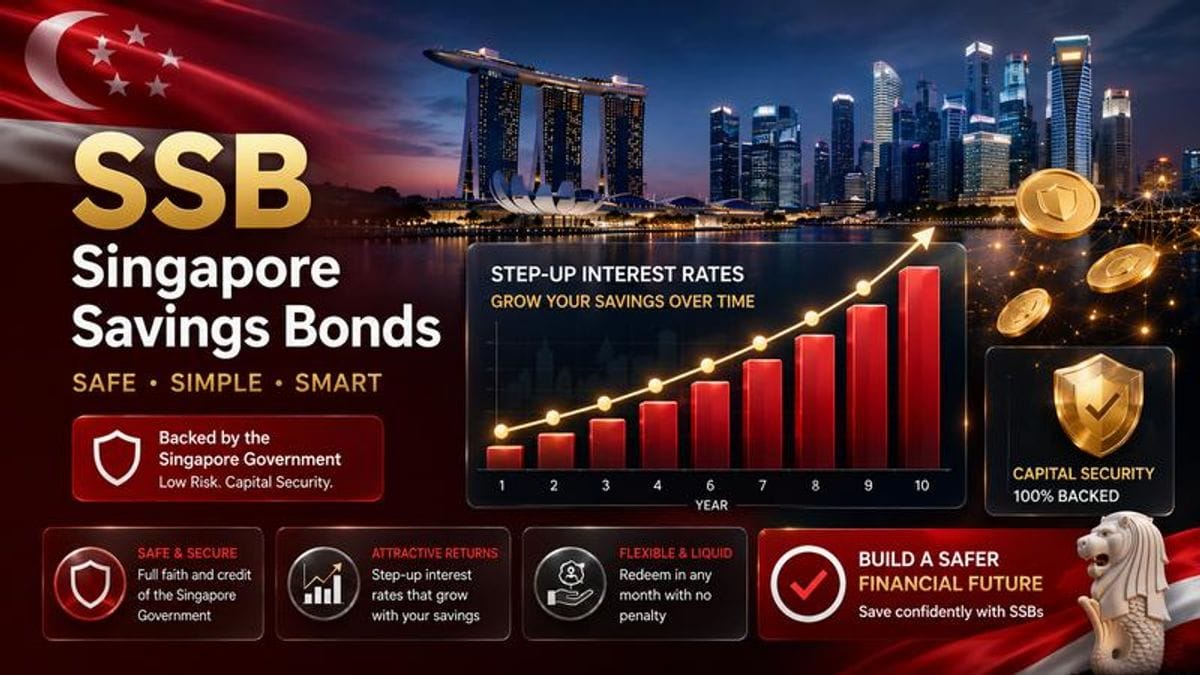
An SSB fixes all ten years of coupons the day it is issued, in a step-up ladder: lower in year one, rising to above-average by year ten, engineered so your average yield grows the longer you hold. Rate cuts after purchase cannot touch it.

The FD path is different: a great 3.2% promo lasts its term, then you reinvest at whatever the market pays. When central banks ease, renewal offers step down, and a saver rolling 12-month FDs takes that repricing risk ten times in a decade. The chart shows the mechanics: the FD starts ahead, and each renewal is a coin-flip the SSB never has to take.

This cuts both ways, honestly: if rates rise, the FD roller captures the increase while the SSB holder is anchored. But an SSB holder is never truly anchored: redeem next month for $2 and buy the newer, higher-coupon issue. The FD breaker cannot do the reverse without burning interest. The asymmetry always favours the SSB.

Safety fine print, and the ladder that uses both

Both products are safe; the guarantees differ above $100,000. Bank deposits are insured by SDIC up to S$100,000 per depositor per bank: a $250,000 FD at one bank leaves $150,000 resting on the bank itself, not the scheme. SSBs are direct obligations of the Singapore Government at any amount within the $200,000 individual limit. For six-figure cash, that distinction is worth respecting: fill the SSB limit, then spread FDs across banks in $100,000 slices.

The practical entry mechanics: SSBs are issued monthly, applications run roughly the 1st to the 25th via DBS/POSB, OCBC or UOB internet banking or ATMs, you need a CDP account, and oversubscribed issues are allotted in $500 blocks, so large applications may be partially filled in popular months. Interest is paid every six months and is tax-free for individuals, as is FD interest at licensed banks.

The strategy most Singapore savers land on: emergency fund and undated goals into SSBs (staggered across a few issues so redemptions are granular), dated obligations into the best FD promo you can find for exactly that term, and every new SSB issue's rate checked once a month: if a new issue meaningfully beats one you hold, the $2 redemption fee makes upgrading nearly free. Interest from both products also stays outside your CPF and tax filings entirely, so there is no year-end admin either way.


The Verdict

Certain timelines favour the FD's higher promo rate; any uncertainty at all favours the SSB.

The comparison turns on one question: how sure are you about when you'll need the money? Dead certain, a renovation payment in exactly 12 months, take the highest FD promo rate and collect the extra yield; the lock costs you nothing you'll feel. Anything less than certain, and the SSB's exit rights dominate: full accrued interest out any month for $2, against an FD break that hands the interest back to the bank. That makes SSBs the natural home for emergency funds and any medium-term money, with the 10-year locked step-up as a bonus if rates fall. Larger savers do both: SSB to its practical limit, FDs for the overflow, ideally laddered so something matures every few months.

Choose Fixed Deposit if...

Savers with a fixed, known deadline inside 12 months, and anyone parking sums beyond the SSB's $200,000 cap.

Choose Singapore Savings Bonds (SSB) if...

Emergency funds, house-deposit money without a confirmed date, and anyone who values a decade of locked rates with a free exit.

Built & MaintainedBuilt by Galvin Mendonca, Finance Researcher
All figures from primary government sources. Last updated July 25, 2026.

Frequently Asked Questions

You Might Also Like

View All

Sources & references

The rules and figures on this page are researched from official primary sources:

Disclaimer: The comparison data, simulator outputs, and projections on this page are provided for general informational and educational purposes only. They do not constitute financial, investment, tax, or legal advice. All values are estimates based on statutory data and hypothetical inputs. Interest rates, contribution limits, tax brackets, and regulatory rules change frequently and vary by jurisdiction. Always consult a qualified professional advisor and verify critical figures with official government publications before making any financial decisions.