Calculator
Inflation Impact Calculator
Examine how rising prices erode the future purchasing power of your cash.
Try it nowCalculate how much inflation erodes your cash purchasing power over time. Compare historical CPI rates and see what your savings will actually buy.
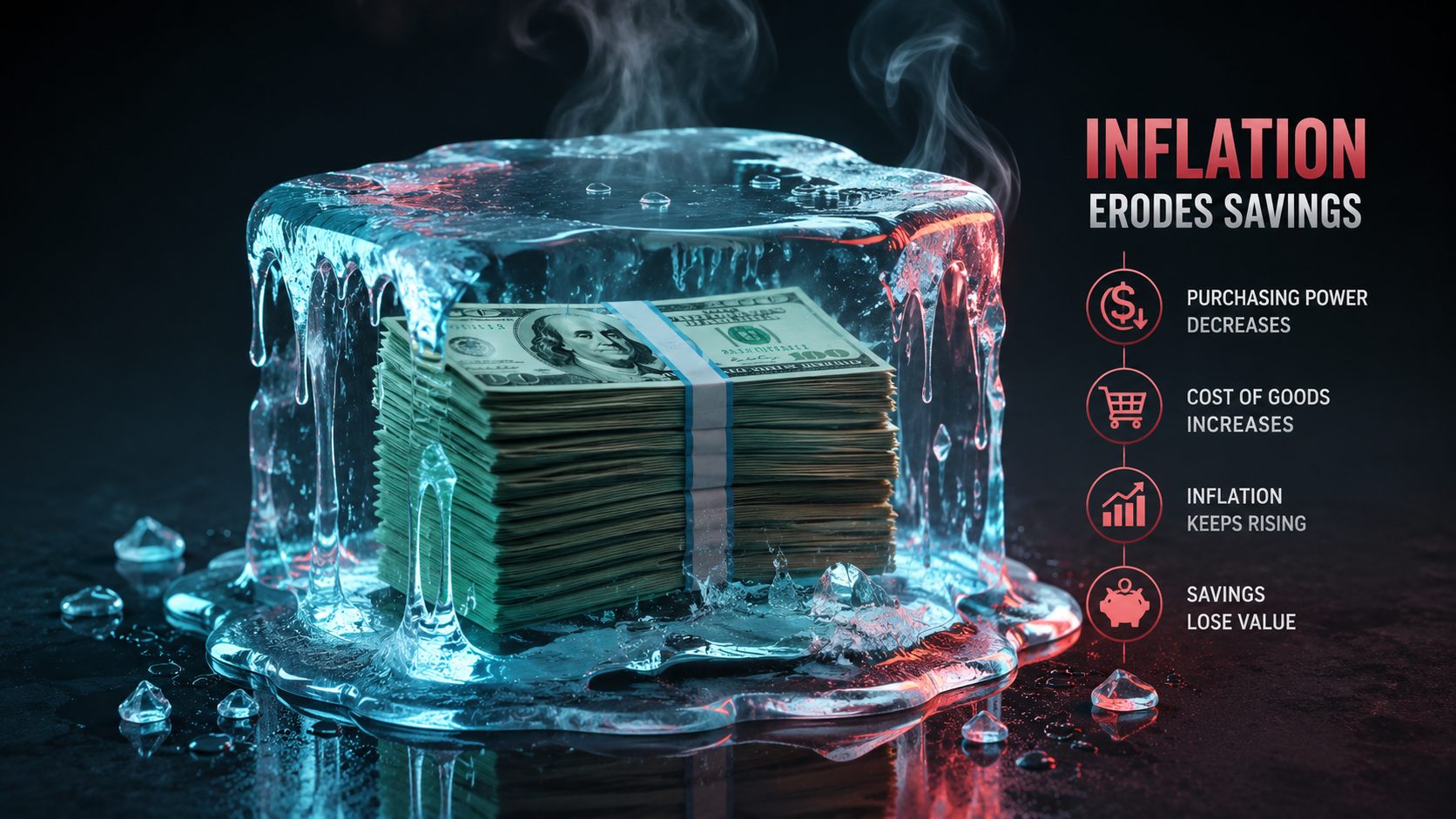
Keep $10,000 in a zero-interest account for a decade at 3% inflation and it quietly becomes $7,374 of buying power. Nothing on your statement changes; what it buys does. Set your balance, an inflation rate, and a horizon, and this calculator shows exactly how much real value leaks away and how fast.
Inflation is the yearly rise in what things cost, which is the same as a yearly fall in what your cash is worth. At 3%, the $100 basket costs $103 next year. One year is invisible; twenty compounding years cut cash nearly in half, which is why parking long-term money in a checking account is a decision with a price, not a neutral default.
The bar is lower than people think: your money only has to grow faster than prices. High-yield savings accounts and CDs usually clear it for near-term cash, TIPS are built to track it by design, and for 10-year-plus money, broad stock and property exposure has historically beaten it by the widest margin. The 0.1% account loses to inflation every year it exists.
Nobody feels 3% inflation in a single year: it is a coffee here, a renewal notice there. The damage is in the compounding. At 3%, cash loses a quarter of its buying power in 10 years and more than half over a 25-year retirement. And 3% is the polite historical average, not a ceiling; the 2021-2023 spike ran at double and triple that pace and repriced everything from rent to groceries in under three years.
That makes idle cash a position, not a neutral choice. Holding $50,000 in a zero-interest account at 3% inflation costs about $1,500 of real value in year one alone, roughly what a bad stock pick might lose you, except this loss is guaranteed, repeats every year, and never shows up on any statement you receive.
A 4% savings rate during 3% inflation is a 1% real gain. A 1% rate during the same inflation is a guaranteed 2% annual loss dressed up as prudence. Always subtract inflation before deciding whether a rate is worth anything.
Tax makes the real number worse, because it is charged on the nominal interest, not the real gain. A 4.5% rate taxed at 24% nets 3.42%, which at 3% inflation is a real return of well under half a percent. Plenty of accounts that look like winners before tax are treading water after it.
The practical split: cash you need within a couple of years belongs in the highest-yield safe account you can find, where the real loss is small and the liquidity is the point. Money with a 10-year-plus horizon needs assets that have historically outrun inflation, because no savings account reliably does.
The official rate is an average across a national shopping basket. If your budget is heavy on rent, tuition, or medical costs, categories that have persistently outrun headline CPI, your personal inflation rate is higher than the number in the news.
Run this calculator twice: once at the official rate, once at a rate weighted to what you actually buy. For a renter with kids heading to university, the second number is often a full point higher, and over 20 years that one point is the difference between losing a third and losing nearly half.
Retirement planning fails quietly here. A $50,000-a-year lifestyle does not cost $50,000 in twenty years: at 3% inflation it costs about $90,300, and by year 30 of a long retirement, roughly $121,400. A nest egg sized for today's prices funds a shrinking life.
The fix is to plan in real terms. Size the target off inflated future spending, favour income sources with built-in adjustments where you can get them, and treat any flat annuity or fixed pension as a melting asset: reliable in dollars, shrinking in groceries.
Check which of your future income streams adjust and which do not. Social Security carries an annual cost-of-living adjustment; most private pensions and fixed annuities do not, so a plan leaning on the flat ones needs the portfolio to grow enough to cover the widening gap.
The same subtraction applies to income. A 4% salary bump during 3% inflation is a 1% real raise; a 2% bump is a pay cut wearing a bow. Whole years of career progress can be inflation-neutral without anyone noticing, because the nominal number always goes up.
When you negotiate, anchor on the real figure: last year's inflation plus the raise you actually want. And when comparing an old salary to a new offer across several years, deflate both to the same year's dollars first, the ten-percent-bigger number from three years ago may be smaller money.
None of this argues for holding zero cash. An emergency fund of three to six months of expenses earns its keep by preventing something worse than inflation: selling investments at the bottom, or reaching for a 24% credit card when the transmission dies. Its job is availability, not return.
The working framework is to price the protection. Six months of expenses, say $30,000, parked at 1.5% below inflation costs about $450 a year in real value. That is the insurance premium. Pay it deliberately on the emergency fund, and refuse to pay it on the $80,000 beyond it that is sitting in the same account out of inertia. This calculator tells you exactly what the inertia costs; the decision about which dollars deserve protection is yours.
This is compound interest running against you. Each year, inflation shaves a slice off what your cash can actually buy, and next year's slice comes off the already-smaller amount. The formula compounds that erosion over your chosen horizon.
Your bank statement never shows it. The nominal number sits still while the real value drains; the calculator makes the drain visible.
Dan keeps $10,000 in a checking account paying nothing, and inflation averages 3% for the next decade.
The decay factor is 0.97 raised to the 10th power, which is 0.7374. His $10,000 will buy what $7,374 buys today.
He lost $2,626 of purchasing power without a single bad decision, a fee, or a market crash. The account balance still says $10,000 the whole time.
Push the horizon to 25 years, the length of a retirement, and the same maths leaves $4,670 of today's buying power. More than half the value is gone.
Review the glossary of terms used in the calculation model below. Click on highlighted links to read more in-depth definitions in our financial glossary:
| Parameter | Definition & Context |
|---|---|
| Starting Cash | The nominal balance being evaluated. The decay applies to whatever portion earns less than inflation. |
| Inflation Rate | Expected average annual rise in your cost of living. Your personal rate can run above the official CPI if your spending skews to housing, healthcare, or education. |
| Term (Years) | The projection horizon. Erosion compounds, so doubling the years far more than doubles the damage. |
The rules and figures on this page are researched from official primary sources: