Calculator
8-City HRA Exemption Calculator (FY 2026-27)
Calculate your HRA tax exemption under the 8-city expanded rule (adding Bengaluru, Pune, Hyderabad, Ahmedabad) for FY 2026-27.
Try it nowCalculate TCS on foreign remittances under India's LRS. Budget 2026: 2% for education/medical above ₹10L, flat 2% on tour packages, 20% otherwise.
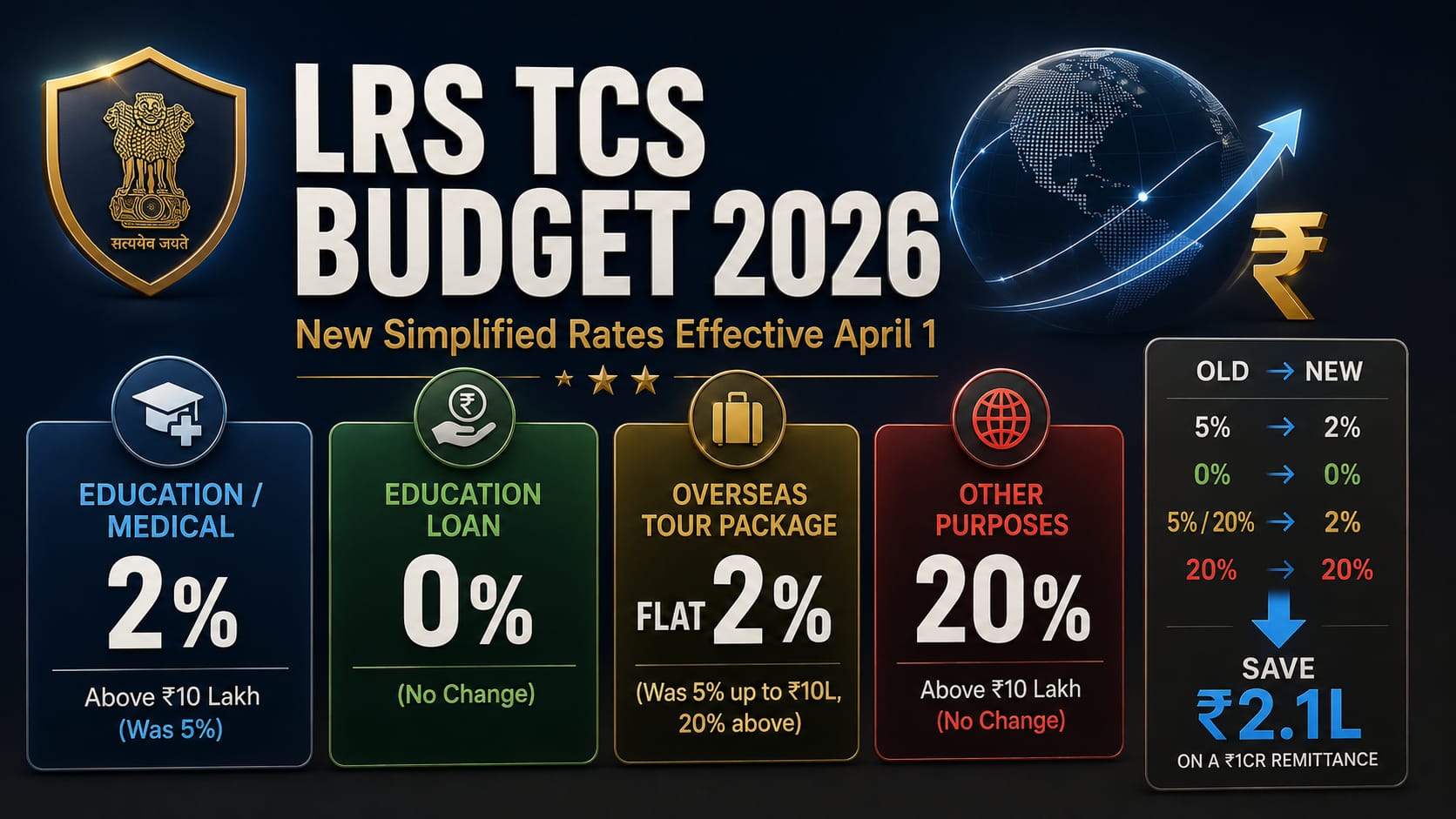
Calculate the Tax Collected at Source (TCS) on your outward foreign remittances under India's Liberalised Remittance Scheme (LRS). Budget 2026 (effective April 1, 2026) reduced education and medical TCS to 2% above ₹10 lakh and simplified overseas tour packages to a flat 2% rate.
The Union Budget 2026, presented on February 1, 2026, rationalised Tax Collected at Source (TCS) rates on outward foreign remittances under the Liberalised Remittance Scheme (LRS): 1. Education and medical remittances: TCS reduced from 5% to 2% on amounts exceeding ₹10 lakh per financial year. 2. Overseas tour packages: Simplified from a tiered 5%/20% structure to a flat 2% rate from the first rupee, no threshold. 3. Education financed by a recognized loan: Remains at 0% TCS with no amount cap. 4. Other LRS purposes (investments, gifts, family maintenance): Unchanged at 20% above ₹10 lakh.
TCS is calculated on the portion of your remittance that exceeds ₹10 lakh in a financial year, aggregated across all LRS transactions and all banks under your PAN. For example, if you've already remitted ₹8 lakh this year and send ₹5 lakh now, TCS applies to ₹3 lakh (the portion above ₹10 lakh total). Tour packages are the exception — TCS at 2% applies to the full amount from the first rupee with no ₹10 lakh threshold.
TCS is an advance tax collection, not an additional tax. It appears in your Form 26AS and Annual Information Statement (AIS). When you file your income tax return, you claim credit for the TCS against your total tax liability. If your TCS exceeds your tax due, you receive a refund. Always track your TCS certificates (Form 27D) from your bank for accurate filing.
Every rupee of Tax Collected at Source lands in Form 26AS under your PAN and offsets your final tax bill; excess gets refunded after you file. On paper it is a timing difference. In your bank account it is real money leaving months early: a ₹15 lakh self-funded tuition remittance in June locks up ₹10,000 until the refund cycle completes the following year.
That reframing changes behaviour in two ways. First, stop optimising to avoid TCS at the cost of worse exchange rates or shady channels, the tax comes back, a bad FX spread does not. Second, keep the Form 27D certificate the bank issues for every collection; it is your proof when 26AS and your return need to reconcile, and chasing a missing certificate in filing season is nobody's favourite week.
The threshold aggregates across ALL your LRS remittances in the financial year, every purpose except tour packages, every bank, tracked against your PAN. Send ₹4 lakh for a cousin's tuition, ₹3 lakh for a medical bill, and ₹4 lakh as a gift, and you are ₹1 lakh over the line even though no single transfer looked threatening.
Banks see their own ledger, not each other's, so the reporting burden of cross-bank aggregation is effectively yours: declaring prior remittances accurately on each bank's LRS form is what keeps the collection correct at source instead of becoming a mismatch notice later. Tour packages are the exception in both directions, they never count toward the ₹10 lakh pool, and they get their own flat 2% from the first rupee.
Budget 2026's contribution was rate relief: education and medical remittances above the threshold dropped from 5% to 2% with effect from 1 April 2026, and the old two-tier tour package structure (5% then 20%) collapsed into the flat 2%. On a ₹20 lakh package, the upfront collection fell from ₹2,50,000 to ₹40,000, cash-flow relief of over ₹2 lakh for the same holiday.
Remittances funded by an education loan from a recognised financial institution attract ZERO TCS, no threshold, no rate, nothing. A family remitting ₹30 lakh across two years of a foreign degree pays ₹40,000 of upfront TCS if self-funded and ₹0 if the same money routes through a Section 80E-recognised loan, on top of whatever interest deduction the loan itself earns.
The route matters mechanically: the bank applies the exemption when the remittance is coded as loan-funded education and the loan paperwork is on file. Families who take the loan but remit from a savings account out of habit pay TCS they never owed. If the loan exists, remit from the loan disbursement flow and say so on the form.
For everyone else, sequencing still helps at the margin: a family planning both a tour package and a tuition remittance cannot share thresholds between them anyway, but timing large gift-purpose transfers across two financial years splits them over two ₹10 lakh pools legitimately.
At filing time the TCS credits in Form 26AS and AIS set off against your total tax liability, salary TDS already covering most of it means the TCS usually converts into a refund. The reconciliation failures are mundane: a remittance made under a family member's PAN whose return never claims it, a bank coding the purpose wrong, a missing 27D. Check 26AS a month after any large remittance, while the bank can still fix its reporting easily.
Salaried remitters have a smoother lever since the rules began allowing TCS to be set off against salary TDS: hand your employer the TCS details and monthly withholding drops correspondingly, converting the year-end refund into current-year cash flow. For a parent making regular tuition remittances, that is the difference between financing the government interest-free for a year and not.
Tax Collected at Source (TCS) on foreign remittances under India's Liberalised Remittance Scheme (LRS) is calculated under Section 206C(1G) of the Income-tax Act. The TCS amount depends on three factors: the purpose of the remittance, the cumulative amount remitted in the financial year, and whether an education loan is involved.
The general rule: no TCS on the first ₹10 lakh of aggregate LRS remittances in a financial year. Beyond ₹10 lakh, rates vary by purpose. The exception is overseas tour packages, which attract 2% TCS from the first rupee with no threshold. TCS is creditable against your final tax liability — it is a deposit, not a cost.
Rohit remits ₹15 lakh in June 2026 for his daughter's university tuition abroad, self-funded, no education loan, and no other LRS remittances this financial year.
Cumulative LRS remittances hit ₹15,00,000, crossing the ₹10,00,000 threshold; TCS applies to the ₹5,00,000 excess.
Self-funded education carries a 2% rate: ₹5,00,000 × 2% = ₹10,000 of TCS.
His total cash outlay is ₹15,10,000: the ₹15 lakh remittance plus ₹10,000 collected by the bank.
That ₹10,000 shows up in his Form 26AS, and when Rohit files his ITR he claims it as credit against his tax bill, or gets it refunded if his liability is lower.
Review the glossary of terms used in the calculation model below. Click on highlighted links to read more in-depth definitions in our financial glossary:
| Parameter | Definition & Context |
|---|---|
| Remittance Amount | The amount of money you are sending abroad under the Liberalised Remittance Scheme (LRS) in a single transaction. |
| Cumulative FY Remittances | The total amount of all LRS outward remittances made in the current financial year prior to this transaction, aggregated across all banks and purpose codes under your PAN. |
The rules and figures on this page are researched from official primary sources: