Calculator
NZ FMA CCCFA Consumer Credit Complaint Eligibility Checker (2026)
Check your complaint eligibility under the FMA's July 1, 2026 CCCFA regulatory transfer and find the correct escalation path for predatory lending.
Try it nowCalculate your NZ student loan payoff schedule, daily interest, and compulsory repayment brackets as an overseas borrower at the IRD 2026 rate of 5.6%.
Stay out of New Zealand past 184 consecutive days and your interest-free student loan starts charging 5.6%, backdated to the day after you left. Enter your balance and any voluntary top-ups; the calculator runs the IRD's fixed assessment bands against the interest clock and shows your payoff year, total cost, and whether your balance is quietly growing instead of shrinking.
In New Zealand, student loans are interest-free only if you reside in the country. If you move overseas and remain out of New Zealand for more than 184 consecutive days, your loan ceases to be interest-free. You are classified as an 'overseas-based borrower' from the day after you leave New Zealand, and interest is backdated and charged from that day.
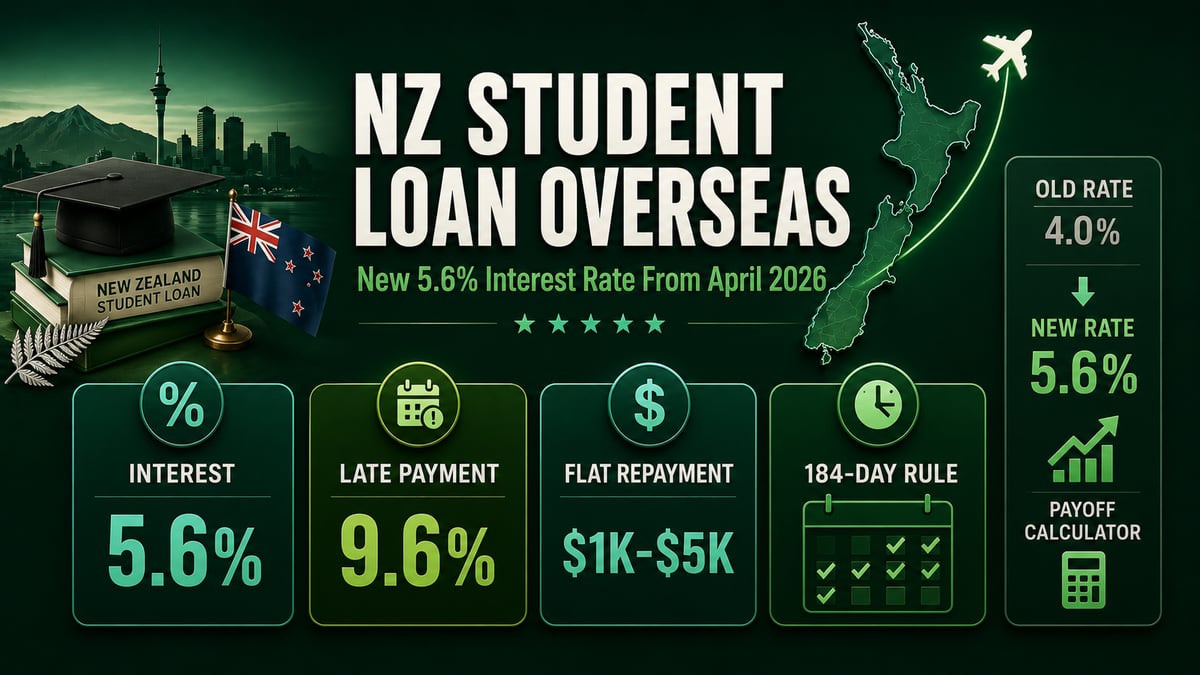
Unlike NZ-based borrowers whose repayments are deducted from their wages as a percentage of income, overseas-based borrowers face compulsory annual repayments based entirely on their total loan balance. These obligations are divided into brackets, ranging from $1,000 per year for balances under $15,000 to a flat $5,000 per year for balances over $60,000. These payments are due in two installments on September 30 and March 31.
As of April 1, 2026, the interest rate for overseas-based borrowers is 5.6% per annum, calculated daily and applied annually. If your loan balance is high, the interest charged can easily exceed your compulsory repayment bracket. For example, a $100,000 loan balance accrues $5,600 in interest in the first year, which is more than the maximum compulsory repayment of $5,000. This causes your loan balance to grow indefinitely (negative amortization) unless you make voluntary extra payments.
If you fail to make your assessment payments on time, the IRD charges a late payment interest rate of 9.6% per annum (up from 8.9%) on the overdue amount. This penalty interest compounds monthly and can quickly lead to a debt spiral. Setting up an approved repayment instalment plan can reduce this rate to a reduced penalty of 7.6%.
Inside New Zealand the loan is interest-free, so ignoring it is rational. The 184-day rule ends that: once you have been away more than 184 consecutive days, interest applies from the day AFTER you left, backdated, not from the day you crossed the threshold. A working holiday that stretches into a second year quietly reprices your entire balance, and the IRD does not send a warning shot before it happens.
The IRD does not care what you earn in London or Sydney; overseas assessments are fixed dollar amounts tied to the balance. That cuts both ways: low earners abroad owe more than 12% of nothing, and high earners owe far less than they would at home, unless they volunteer more. Either way the two instalments fall due in September and March, and the amounts are visible in myIR well in advance, so there is never a good excuse to be surprised by them.
At 5.6%, a balance above about $90,000 accrues more interest ($5,040+) than the largest compulsory payment ($5,000) can cover, so paying exactly what the IRD asks means owing more every year, forever.
If that is you, the minimum payment stops being a repayment plan and becomes a subscription fee for carrying the debt. The escape is voluntary extras aimed at dragging the balance below the crossover point, after which the same $5,000 assessments finally start eating principal. Every early extra dollar works twice: it cuts this year's interest and lowers every future year's starting balance.
Prioritise the order of attack too: if you also carry overseas credit cards or personal loans, their rates almost certainly exceed 5.6%, so they die first. The NZ loan's rate is painful by student-loan standards but cheap by consumer-credit standards, which makes it the right SECOND target, not the wrong first one.
Miss an assessment and late payment interest of 9.6%, compounding monthly, applies to the overdue amount, nearly double the base rate. Arrange an instalment plan with the IRD and that penalty rate drops to 7.6%, which is the cheapest phone call in this whole system.
The operational traps are mundane: borrowers who never told the IRD they left, notices going to a dead email address, assessments missed out of ignorance rather than inability. Keep myIR current, set the two annual payment dates (September and March) as recurring reminders, and the penalty regime never touches you.
Return to New Zealand for good and the loan does not become interest-free at the arrivals gate: you need to be back in the country long enough to regain NZ-based status under the same day-counting logic that took it away. Once you do, interest stops, and repayments revert to the salary-deduction system, 12% of income above the repayment threshold, collected through PAYE like tax.
That mechanical difference creates a genuine strategy question for anyone planning a return: large voluntary payments made while overseas fight 5.6% interest, but the same dollars paid after re-establishing NZ-based status fight a 0% loan. If your return date is close and your balance is under control, the mathematically patient move is often to pay the compulsory minimum abroad and redirect the surplus at the loan only if you decide to stay overseas after all. Just do the sums with the calculator above rather than by feel, because the answer flips with the balance size.
Leave New Zealand for more than 184 consecutive days and your interest-free student loan starts charging 5.6% a year (the overseas-based rate from 1 April 2026), while your repayments switch from a slice of salary to fixed annual amounts based on the balance.
The calculator loops that equation year by year: add a year's interest, subtract your compulsory assessment plus any voluntary extras, and repeat until the balance dies, or show you that it never will.
Rewa moved to London with a $25,000 loan and pays $1,000 a year on top of her compulsory amount.
Her band sets the compulsory payment at $2,000, so $3,000 goes in each year against $1,400 of first-year interest: the balance genuinely falls, and every year it falls the interest line shrinks with it.
The simulation clears her loan in roughly 16 years, at about $36,200 total paid, $11,200 of it interest.
Her flatmate with a $95,000 balance and no extras is in a different story: 5.6% on $95,000 is $5,320 of interest against a $5,000 maximum compulsory payment. His balance rises every single year he pays only the minimum.
Review the glossary of terms used in the calculation model below. Click on highlighted links to read more in-depth definitions in our financial glossary:
| Parameter | Definition & Context |
|---|---|
| Current Student Loan Balance ($) | The outstanding NZ student loan shown in myIR. It sets both your compulsory band and your interest bill. |
| Annual Extra Voluntary Payments ($) | Anything you pay beyond the assessment. On large balances this is the only thing standing between you and negative amortisation. |
The rules and figures on this page are researched from official primary sources: