The Day the RBI Ended "Buyer Beware" in Indian Banking
On June 15, 2026, the Reserve Bank of India issued final directions on Advertising, Marketing, and Sales of Financial Products and Services—and the single most important line in the entire circular is this: if a bank or NBFC is found to have mis-sold you a financial product, it must refund 100% of the amount collected. Not a partial refund. Not a goodwill gesture. The full amount.
This is not a draft. The RBI published draft Amendment Directions on February 11, 2026, invited public comments until March 4, and then issued the final directions on June 15, 2026. The effective date is January 1, 2027. Banks and NBFCs have six months to overhaul their sales processes, retrain their agents, and rebuild their digital consent flows.
Warning
The final directions take effect on January 1, 2027, not July 1, 2026 as originally proposed in the February draft. Products mis-sold before January 1, 2027 are governed by the existing complaint framework (RBI Ombudsman, Consumer Protection Act). The new strict-liability refund regime applies to mis-selling that occurs on or after January 1, 2027. However, you can still file complaints about past mis-selling under existing rules—the new directions strengthen your position but do not retroactively apply.
If you have ever been pressured into buying an insurance policy at a loan disbursement counter, had a credit card "free" insurance quietly added to your statement, or been sold a mutual fund by a bank relationship manager who called it "better than a fixed deposit" without explaining the market risk—these rules were written for you.
This guide explains exactly what the RBI banned, what qualifies as mis-selling, how to calculate your potential refund, and the step-by-step complaint process to get your money back.
What the RBI Banned: The Five Prohibited Practices
The final directions target five specific categories of misconduct by banks and NBFCs :
1. Forced Bundling of Third-Party Products
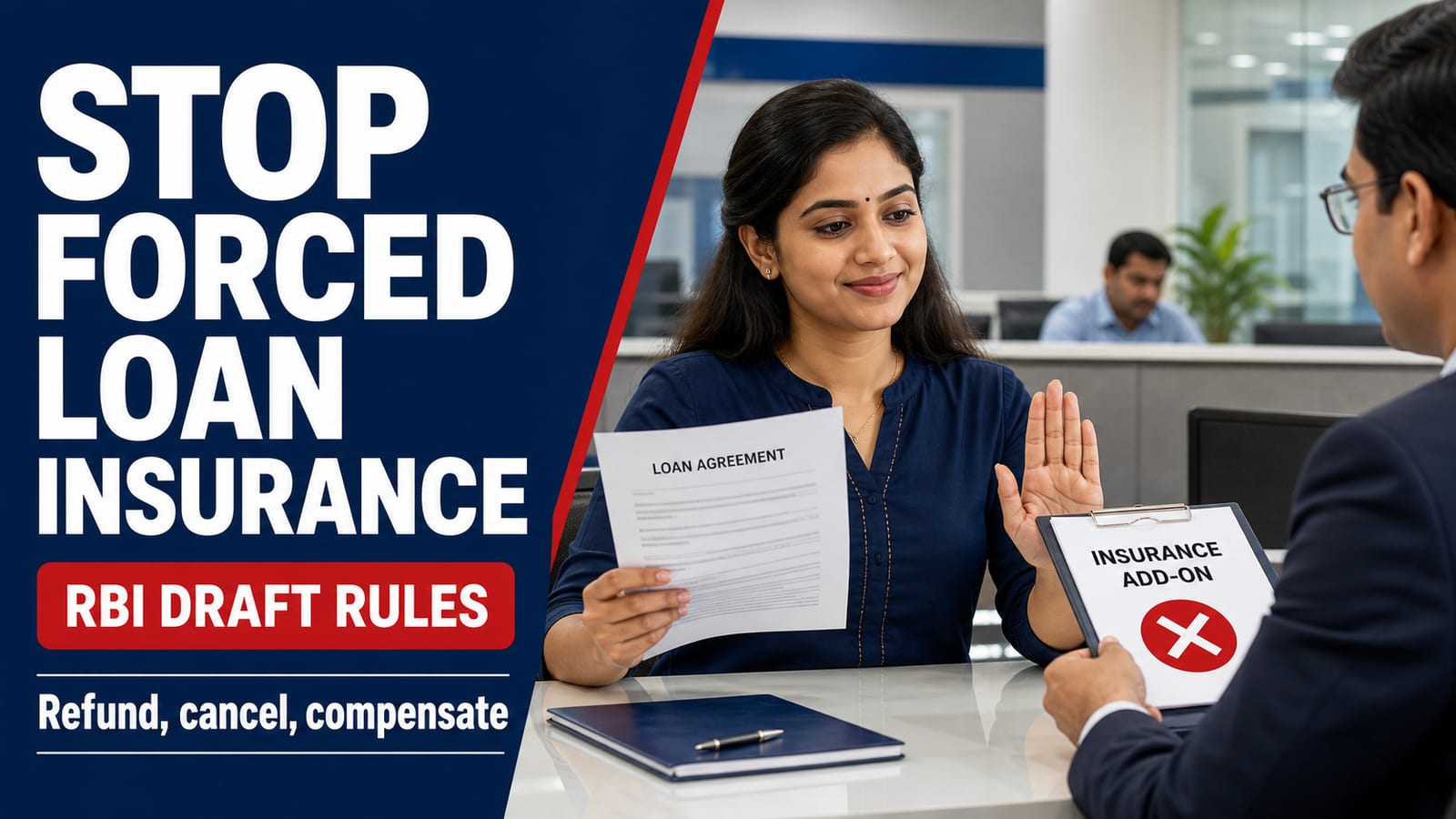
Banks can no longer make the purchase of a third-party product—insurance, mutual funds, NPS, or credit cards—a condition for availing a loan, opening an account, or accessing any banking service.
The classic example: you walk into a bank for a home loan. The loan officer says, "Sir, the loan will be processed faster if you also take our home insurance and life insurance." You sign. You did not want the insurance. You did not compare options. You felt pressured. Under the new rules, this is mis-selling, and you are entitled to a full refund of the insurance premiums paid.
2. Dark Patterns in Digital Banking
Banks and NBFCs are prohibited from using dark patterns—manipulative UI/UX designs—in their mobile apps and websites. This includes:
- Pre-ticked checkboxes for insurance or add-on products during loan applications
- "Confirm" buttons that are visually dominant while "Skip" or "Decline" buttons are hidden or greyed out
- Countdown timers creating false urgency ("This offer expires in 5 minutes!")
- Bundled product selections that require multiple clicks to uncheck
3. Misleading Advertising and Sales Pitches
All advertising, marketing materials, and sales scripts must be "clear, fair, and not misleading". Specific prohibitions include:
- Calling a ULIP or market-linked product "guaranteed returns" or "better than FD"
- Hiding or downplaying risks, charges, lock-in periods, or surrender penalties
- Using fine print to contradict the headline claim
- Projecting past performance as indicative of future returns without a clear disclaimer
4. Selling Without Suitability Assessment
Before selling any third-party financial product, the bank or NBFC must conduct a documented suitability assessment. This means:
- Assessing your financial needs, risk tolerance, and investment horizon
- Recommending only products that match your profile
- Documenting the assessment and your acknowledgment
- Not selling a 20-year ULIP to a 70-year-old retiree who needs liquidity
5. Weak or Absent Consent
The bank must obtain explicit, informed, and documented consent before enrolling you in any third-party product. This means:
- A separate consent form for each product (not buried in a 40-page loan agreement)
- Clear disclosure of the product name, provider, premium/charge, lock-in period, and cancellation terms
- Your signature or digital confirmation specifically for the third-party product
- No "deemed consent" through silence or inaction
Case Study: Arjun's Home Loan Insurance Bundle
Arjun took a home loan of ₹50,00,000 from a private bank in Mumbai in March 2026. At the loan disbursement counter, the relationship manager told him, "You need to take our home loan protection insurance and a life insurance policy. It is mandatory for loan approval." Arjun, anxious to get the loan disbursed before the property registration date, signed both policies.
- Home loan protection insurance: ₹45,000 annual premium (5-year term)
- Life insurance (ULIP): ₹1,00,000 annual premium (10-year term)
- Total first-year outflow for insurance: ₹1,45,000
Arjun's forced insurance bundle: first-year outflow
Arjun never received a suitability assessment. The ULIP was presented as "tax-saving investment" without explaining the 5-year lock-in, the fund management charges (1.5% p.a.), or the mortality charges. The home loan protection insurance was presented as "mandatory"—it was not.
Under the New Rules (Post-January 1, 2027)
If this mis-selling occurred on or after January 1, 2027:
- The bank violated the forced bundling prohibition (insurance is not mandatory for loan approval)
- The bank violated the suitability assessment requirement (no documented assessment)
- The bank violated the consent requirement (Arjun was told it was "mandatory"—not informed consent)
- Arjun is entitled to a 100% refund of all premiums paid: ₹1,45,000 for the first year
If Arjun paid premiums for multiple years before discovering the mis-selling, the refund extends to all premiums paid, not just the first year.
Under Existing Rules (Pre-January 1, 2027)
Since Arjun's mis-selling occurred in March 2026 (before the new rules take effect), he must use the existing complaint framework:
- File a written complaint with the bank's grievance redressal officer
- If unresolved in 30 days, escalate to the RBI Banking Ombudsman
- If still unresolved, approach the Consumer Disputes Redressal Commission
The existing framework does not guarantee a 100% refund, but the RBI Ombudsman has the power to direct compensation. Arjun's case is strong because the insurance was presented as "mandatory"—a clear misrepresentation.
Important
The new directions apply to mis-selling that occurs on or after January 1, 2027. For mis-selling before that date, use the existing RBI Ombudsman scheme and Consumer Protection Act, 2019. However, the new directions set a clear standard that strengthens complaints about past misconduct—you can cite the RBI's own definition of mis-selling in your complaint.
The Compensation Math: What You Can Claim
Under the final directions, the refund structure is straightforward :
| Mis-Selling Type | Refund Entitlement | Additional Compensation |
|---|---|---|
| Forced insurance bundling | 100% of all premiums paid | Interest at the applicable savings rate from date of payment |
| Unauthorized credit card insurance | 100% of all charges deducted | Reversal of any impact on credit score |
| Mis-sold ULIP/mutual fund | 100% of investment amount (or current value, whichever is higher) | Compensation for opportunity cost |
| Hidden charges/fees | 100% of hidden charges | Interest from date of deduction |
| Dark pattern enrollment | 100% of amounts charged | Cancellation of the product without penalty |
Worked Example: Meera's Credit Card Insurance
Meera's bank added a "credit shield" insurance to her credit card at ₹999 per quarter without her explicit consent. She discovered it after 8 quarters (2 years) when reviewing her statements.
- Total charges: ₹999 x 8 = ₹7,992
- Refund entitlement: ₹7,992 (100% of all charges)
- Interest: approximately ₹360 (calculated progressively on quarterly deductions at 4% p.a. savings rate)
- Total compensation: approximately ₹8,352
Meera's unauthorised credit-shield claim
Use our RBI Mis-Selling Compensation Calculator 2026 to estimate your refund based on the product type, premiums paid, and duration.
The Complaint Process: Step by Step
Step 1: Gather Evidence
Before filing any complaint, collect:
- Loan sanction letter and agreement (check for bundled product clauses)
- Insurance policy documents and premium receipts
- Credit card statements showing unauthorized charges
- Call recordings (if available—request them from the bank under RTI or the bank's own call recording policy)
- Emails, SMS, or WhatsApp messages from the bank's sales team
- Any signed forms—check whether you signed a separate consent form for the third-party product
Step 2: File a Written Complaint with the Bank
Write to the bank's Principal Nodal Officer or Grievance Redressal Officer. Your complaint must include:
- Your account number and customer ID
- The specific product(s) you are complaining about
- The date of purchase and the circumstances (who sold it, what was said)
- Why you believe it was mis-sold (forced bundling, no suitability assessment, misleading pitch, no consent)
- The specific relief you want (full refund, cancellation, compensation)
- Copies of all supporting documents
The bank must acknowledge your complaint within 7 days and resolve it within 30 days.
Step 3: Escalate to the RBI Ombudsman
If the bank does not resolve your complaint within 30 days, or you are dissatisfied with the resolution, file a complaint with the RBI Banking Ombudsman:
- Online: cms.rbi.org.in
- No fee for filing
- The Ombudsman can direct the bank to refund, compensate, or cancel the product
- Typical resolution time: 30-60 days
Step 4: Consumer Court (If Needed)
If the Ombudsman's decision is unsatisfactory, you can approach the Consumer Disputes Redressal Commission under the Consumer Protection Act, 2019:
- District Commission: claims up to ₹50 lakh
- State Commission: claims ₹50 lakh to ₹2 crore
- National Commission: claims above ₹2 crore
- Filing deadline: 2 years from the date of the cause of action
Step 5: RBI's Integrated Ombudsman Scheme
For complaints about NBFCs and other regulated entities (not just banks), use the RBI's Integrated Ombudsman Scheme, which covers all RBI-regulated entities under a single window.
What Banks Must Do Before January 1, 2027
The final directions give banks and NBFCs until January 1, 2027 to comply. Here is what they must implement:
- Separate consent forms for every third-party product—no more burying insurance consent in a 50-page loan agreement
- Documented suitability assessments before every sale—the bank must record why a product is appropriate for you
- Removal of all dark patterns from digital platforms—no pre-ticked boxes, no hidden decline buttons
- Sales script compliance—all verbal pitches must match the written product disclosure
- Training and certification of all sales staff—agents must pass a compliance assessment
- Monthly mis-selling complaint reporting to the RBI—banks must report the number and type of mis-selling complaints
- Clawback of agent commissions on mis-sold products—if a product is refunded, the agent's commission is clawed back
Note
The directions apply to all RBI-regulated entities: commercial banks (public and private), small finance banks, payments banks, NBFCs, and cooperative banks. They do NOT apply to insurance companies directly (regulated by IRDAI) or to SEBI-regulated entities. However, when a bank sells an insurance product as a corporate agent, the bank is responsible for the sale conduct.
The Difference Between Mis-Selling and Legitimate Cross-Selling
Not every product recommendation is mis-selling. Banks are still allowed to cross-sell—the key distinction is how they do it :
| Practice | Legitimate Cross-Selling | Mis-Selling |
|---|---|---|
| Presentation | "You may also be interested in..." | "This is mandatory for your loan" |
| Consent | Separate, explicit, documented | Buried in loan paperwork or pre-ticked |
| Suitability | Assessment conducted and documented | No assessment; product pushed regardless |
| Opt-out | Easy, no penalty, no impact on loan | "If you decline, your loan rate increases" |
| Disclosure | Full risks, charges, lock-in explained | "Guaranteed returns," risks downplayed |
If the bank presented the product as optional, conducted a suitability assessment, obtained your separate consent, and disclosed all risks and charges—that is legitimate cross-selling. If any of those elements are missing, you may have a mis-selling claim.
The Bottom Line
The RBI's final directions mark a fundamental shift in Indian banking: from "buyer beware" to "seller be accountable." If a bank or NBFC mis-sells you a financial product on or after January 1, 2027, you are entitled to a 100% refund—no negotiation, no goodwill gesture, no partial settlement. The rules are clear, the penalties are real, and the complaint path is structured. Document everything, file your complaint within 30 days of discovering the mis-selling, and escalate to the Ombudsman if the bank stonewalls. For a broader look at your rights as a borrower in India, see our guide on RBI Credit Bureau Weekly Reporting Rules. Use our RBI Mis-Selling Compensation Calculator 2026 to estimate your potential refund.